
Doug Woodham | November 2026
New interviews and previously unpublished records reveal the remarkable life of Basquiat's mother, from her promising early career and painful separation from her children to her extraordinary wealth and unmarked grave in Brooklyn.
Jean-Michel Basquiat's mother, Matilde Andrades, is usually a minor character in accounts of the artist's life. Also known as Matilde Basquiat, her first name is sometimes spelled Matilda in published accounts. Books, films, and documentaries typically portray her as the loving mother who introduced him to art and later struggled with mental illness. But that familiar narrative tells us remarkably little about the woman herself.
Matilde's life was far more complicated, and in many respects more surprising, than these accounts suggest. Drawing on previously unpublished records and extensive interviews with her relatives, I uncovered new details about her upbringing and early career, the painful circumstances that led her to ask her husband to take responsibility for raising their three children, and how Jean-Michel portrayed her in his paintings. My research also revealed her pride in her son's accomplishments, the extraordinary financial consequences of her death, and how a woman whose interest in her son's artistic estate was worth tens of millions of dollars came to be buried in an unmarked grave in Brooklyn.
These discoveries emerged from my research for Jean-Michel Basquiat: The Making of an Icon (Thames & Hudson, 2025). Together, they provide a fuller portrait of a remarkable woman whose life has largely remained in the shadows of her famous son.
Matilde Andrades's Early Life and Marriage
Matilde Andrades grew up in Brooklyn in a household shaped by resilience and ambition. Her parents had immigrated from Puerto Rico and encouraged her to be strong and self-reliant. She attended Washington Irving High School, an all-girls public school near Gramercy Park, commuting from Brooklyn to Manhattan for her education. After graduating, she joined New York Bell, the local telephone company, eventually advancing to a supervisory position. Her youngest brother, Reuben Andrades, Sr., remembered her as a sophisticated, articulate woman with a keen understanding of the world. “For being a Puerto Rican Black woman in those days,” he told me, “she achieved a great deal and went pretty high up at New York Bell.”
In June 1959, Matilde married Gérard Basquiat, a young Haitian immigrant who had arrived in New York four years earlier. She was twenty-four, he was twenty-three. It was Matilde's second marriage and Gérard's first. Their early happiness was interrupted when Matilde miscarried their first child, a boy. She soon became pregnant again, giving birth to Jean-Michel in December 1960.
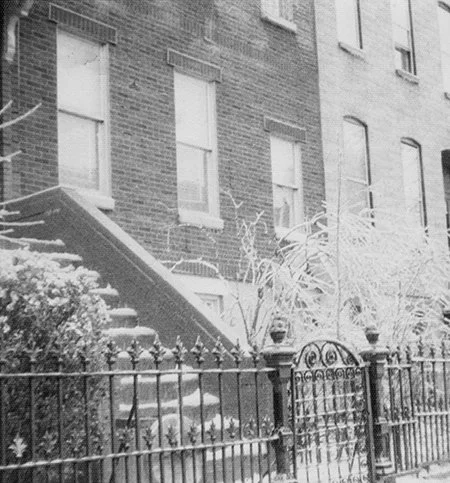
The Andrades family town house in Bushwick, Brooklyn, where Jean-Michel lived as a young child.
The young family settled into a three-story house at 36 Covert Street in Bushwick, Brooklyn, owned by Matilde's parents. They occupied the first floor, Matilde and Gérard lived on the second, and an uncle's family occupied the third. Other relatives occasionally stayed with them. The arrangement created a lively, multigenerational household in which family ties and Puerto Rican traditions were central to daily life.
Spanish was the language of the household, and Jean-Michel became fluent in it. His grandfather and uncle played in local Puerto Rican bands, rehearsing in the basement before their weekend performances. Religion was also important. Matilde's mother, Flora, was a devout Christian who ensured that the family attended the First Spanish Presbyterian Church of Brooklyn. Yet Flora also knew of her family's Jewish ancestry, which had been passed down through generations of Caribbean families. Matilde was aware of this heritage, although she, like her mother, practiced Christianity. This little-known aspect of the family's history also meant that Jean-Michel had Jewish ancestry, a discovery I explore in greater detail in my article, “Was Jean-Michel Basquiat Jewish?”.
After five years on Covert Street, Matilde and Gérard purchased a two-story brownstone in East Flatbush, a Brooklyn neighborhood with a substantial Caribbean immigrant population. By then, their daughter Lisane had joined the family. Both parents placed a high value on education, enrolling Jean-Michel at Saint Ann's School, a private institution in Brooklyn Heights. Matilde was determined to give her son every opportunity to develop his talents. At some point, she set aside her own career ambitions, leaving her job at New York Bell to devote more time to Jean-Michel and support Gérard.
Jean-Michel's seemingly happy childhood, however, was shattered by three traumatic events when he was seven years old. The first occurred when he ran into the street while playing with friends near the family's home and was struck by a car. His injuries required multiple surgeries, including the removal of his spleen, and nearly a month in the hospital. During his recovery, Matilde gave him a copy of Gray's Anatomy, an illustrated reference book on human anatomy first published in 1858. By then, the book had undergone more than twenty-five revisions and expanded to over 1,400 pages, with detailed illustrations of the body's bones, muscles, and internal organs. It was an unconventional gift for a seven-year-old recovering from serious injuries, but one that reflected Matilde's understanding of her son's intellectual curiosity. Jean-Michel used the book to better understand his broken arm and damaged internal organs. Its anatomical illustrations would later become an important source of imagery in his paintings.
The next blow came while Jean-Michel was recuperating at home, when Matilde's marriage began to disintegrate. Suspecting Gérard of infidelity, she confronted him, and the dispute escalated into a physical altercation in which she injured his legs with a hammer. Gérard left the family home and returned only sporadically, leaving Matilde to care for their three young children.
Over the following months, the Andrades family rallied around Matilde, but the stress became overwhelming. She suffered a nervous breakdown. Her decline was fast and precipitous, and she was admitted to Kings County Hospital in Brooklyn. Her youngest brother, Reuben Andrades, Sr., recalled taking her to the hospital while listening to her distressed cries of confusion and despair: “What's wrong with me; what's happening to me?” She remained hospitalized for several months. During this time, Gérard returned to the family home to care for Jean-Michel, his four-year-old sister Lisane, and their one-year-old sister Jeanine.
As Matilde's discharge approached, she worried about what would happen to her children. She wanted them to lack for nothing, but believed that men ruled the world and feared Gérard might withdraw his emotional and financial support if she continued raising them. To protect their future, she asked Gérard to take responsibility for raising the children. He agreed.
Matilde returned to her parents' home on Covert Street without her children.
The absence of his nurturing and supportive mother was a devastating loss for Jean-Michel. Matilde had been his emotional anchor, and her departure left a profound void in his life. Although she received treatment and medication, she never fully recovered or returned to her previous self. Over the years, her mental illness would sometimes flare up, with occasional hospital readmissions. While her exact diagnosis is unclear, her younger brother believes it was likely schizophrenia. Treatment usually involves lifelong medication and substantial family support. While Matilde received early intervention, the medications, especially those prescribed in the 1960s, often had the side effect of flattening her personality.
Jean-Michel was acutely aware of the changes in his world. The mother he adored, who continued to show him affection and appeared unchanged outwardly, was now grappling with a condition beyond his understanding. These early traumas had a profound effect on him. His cousin, Reuben Andrades Jr., remembers the day when Jean-Michel finally appreciated that his parents had separated and that he would no longer live with his mother.
“He was a total wreck. I remember him crying and screaming to my grandmother about his family when he was visiting us at the Covert Street house. He was so hurt by the whole thing. His parents were no longer together, and his mom was sick with something serious. It didn't sit well with him for a very, very long time, if ever. I remember vividly the emotions, the drama, and my grandmother crying while she was trying to console Jean-Michel. But he just ran out of the house screaming.”
Within a relatively short period, Matilde had lost her marriage, her health, and the opportunity to raise her children. The educated, independent woman who had established a successful career and taken such an active role in her son's development now faced a very different future.
How Basquiat Portrayed His Mother
Jean-Michel Basquiat frequently drew on his personal experiences when choosing subjects for his paintings. His mother's struggle with mental illness was no exception. In Masonic Lodge, he filled a vivid indigo-blue canvas with line drawings of a human skull depicted from different angles, resembling illustrations from Gray's Anatomy. At the center of the fragmented skull is an “evil eye” motif, a symbol associated in many cultures with the supernatural power to inflict harm or misfortune. At the top of the composition, Basquiat painted the words “PARANOID SCHIZOPHRENIA,” only to scratch out most of the letters. The painting can be read as a poignant, intricately coded portrayal of Matilde's struggle with mental illness.
Basquiat also painted portraits of friends and family members, including two large works depicting his parents. Titled Mater and Pater, after the Latin words for “mother” and “father,” the paintings measure approximately seven by six feet and feature his signature expressionist style. Rather than depicting his parents clothed, as one might expect, Basquiat painted them as naked figures. While nude portraits of friends and lovers have a long history in art, artists have rarely portrayed their parents this way.
In Mater, Matilde's muscular body faces the viewer. Her breasts are painted red, and her triangular pubic area is defined with white paint against a black background. Her outstretched arms and grasping hands convey a sense of energy and strength. Around her head, Basquiat painted a circle with lines radiating outward, suggesting a halo. Given Matilde's deeply held Christian beliefs, the image can be interpreted as a form of deification, an expression of the reverence Jean-Michel felt for his mother.
The contrast with Pater is striking. Gérard's face has a goofy expression, while his genitalia are rendered in the crude style of bathroom-wall graffiti. Where Matilde appears powerful and almost saintly, Gérard is depicted in a manner that invites ridicule. The two paintings suggest the very different feelings Jean-Michel harbored toward his parents, even as both remained important figures in his life.
These deeply personal references illustrate how Basquiat transformed elements of his life into art, a process I examine more broadly in my article, “How to Understand a Basquiat Painting Without Pretending to Decode It.”
A Bittersweet Homecoming
In 2005, the Brooklyn Museum mounted a major retrospective of Basquiat's work, featuring more than one hundred paintings and drawings spread across two floors. It was the first comprehensive exhibition of his work in New York since the Whitney Museum's 1992 retrospective. The exhibition served as a tribute to one of the borough’s most famous figures.
Matilde was invited to the private opening and asked her youngest brother, Reuben Andrades, Sr. to accompany her. “I used to spend a lot of time with her because I lived a few blocks away, with my family,” Reuben told me. “She wanted to see the show but insisted that I accompany her, so I took her there.”
For Matilde, it was a return to a familiar place. Decades earlier, she had taken Jean-Michel to the Brooklyn Museum as a child, encouraging his curiosity about art and introducing him to the works on display. Now, seventeen years after his death, the museum was honoring her son with an exhibition that drew visitors from across New York and beyond.
Matilde and Reuben walked through the exhibition on their own, taking in the paintings and drawings. “She was proud of him, you know, proud of what he accomplished,” Reuben recalled. It was a rare opportunity for Matilde to see the full extent of her son's artistic achievements gathered in one place.
After touring the exhibition, Matilde and Reuben returned home. Only later did they discover that a grand-opening celebration had taken place that evening, complete with speeches and a dinner. Neither Gérard nor Matilde's daughters had invited them to participate.
A Fortune and an Unmarked Grave
Three years after the Brooklyn Museum retrospective, Matilde died of cancer at the age of seventy-four. A memorial service was held a few days later, with a program featuring her favorite photograph on the cover. Beneath the image was a caption in her own handwriting: “I like this picture, it shows my happiness.”
During the service, Reuben Andrades Jr., Matilde's oldest nephew, spoke about his memories of her. “Matilde was a good person, and I spent a lot of time with her,” he later told me. “She faced challenges with a mental illness, but it didn't define her all the time. Matilde was the type of person who meant what she said and did exactly what she said she would do. She was a serious person, just like her father, who was my grandfather. She had the same dignity as him. When my grandfather spoke, everyone listened.” Reuben also recalled the close bond between Matilde and Jean-Michel. “He was very attached to her and loved her deeply.”
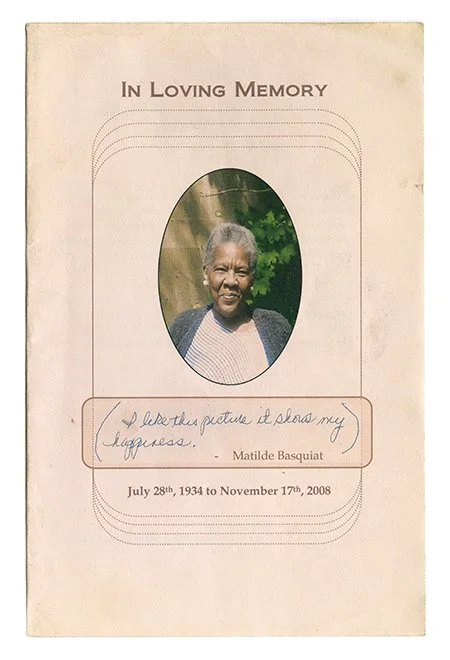
The cover of the program distributed at Matilde's funeral, November 2008.
Matilde's daughters, Lisane Basquiat and Jeanine Heriveaux, attended the memorial service but chose not to speak. Gérard did not attend.
Following Matilde's death, two surprising facts came to light. Despite having lived apart since 1967, Matilde and Gérard had never formally divorced. Nor had Matilde left a will. Both circumstances would have significant consequences for the ownership and management of Jean-Michel's artistic estate.
When Jean-Michel died without a will in 1988, his parents inherited his estate in equal shares under New York law. Matilde therefore owned half of an increasingly valuable collection of paintings and drawings, even as she continued to live modestly in Brooklyn. Because Matilde died without a will and remained legally married to Gérard, New York's intestacy laws determined how her estate would be distributed. Half passed to Gérard, free of federal estate taxes under the marital deduction, while the remaining half was divided equally between her two daughters. The result was that Gérard's ownership of Jean-Michel's estate increased from 50 percent to 75 percent, while Lisane and Jeanine each acquired a 12.5 percent interest.
Gérard had managed the Basquiat estate since his son's death, overseeing a business that generated revenue from both the sale of artwork and the licensing of Basquiat's imagery. I examine the latter in greater detail in my article, “How the Basquiat Estate Used Licensing to Build a Global Brand.”
As Matilde's surviving spouse, Gérard was appointed executor of her estate. Apart from her interest in Jean-Michel's estate, she owned little of substantial value: some money in a checking account and a one-quarter interest in the Covert Street house that she shared with her three siblings.
The financial stakes were nevertheless enormous. At Jean-Michel's death in 1988, his estate had been valued at $3.2 million. By the time Matilde died twenty years later, the value of the artwork owned by his parents had increased dramatically. After years of disagreements with the Internal Revenue Service, Gérard and the IRS eventually agreed on a valuation of $147 million as of Matilde's death. Her estate ultimately paid approximately $8 million in federal estate taxes and penalties.
Despite her substantial wealth on paper, Matilde had lived simply. She rarely traveled beyond her Brooklyn neighborhood, made few personal purchases, and avoided spending money on improvements to her home. Her annual living expenses probably never exceeded $25,000. Against that backdrop, the $8 million paid in federal estate taxes and penalties was a staggering sum, highlighting the extraordinary contrast between the value of her ownership interest in Jean-Michel's art and the modest circumstances of her everyday life.
That contrast extended to her burial.
Matilde was laid to rest at Green-Wood Cemetery in Brooklyn, where Jean-Michel had been buried twenty years earlier. The historic cemetery, established in 1838, is known for its rolling hills, winding paths, and elaborate monuments commemorating many prominent New Yorkers.
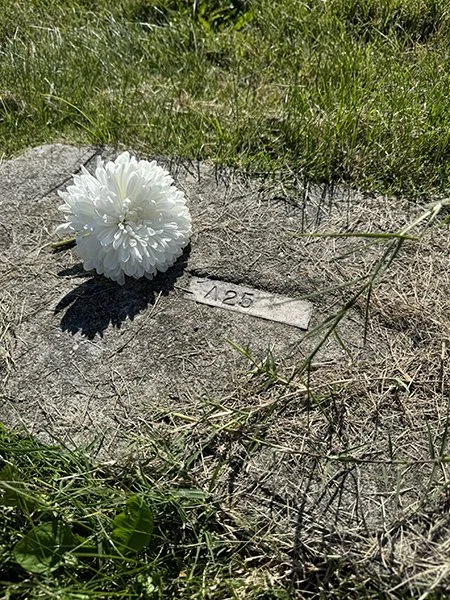
Matilde's grave site marker, October 2024.
When I tried to locate Matilde's grave, the cemetery's online records directed me to an area near Jasmine Avenue. But the location was difficult to identify. Further inquiries revealed that the burial plot was owned by one of her daughters, and a cemetery employee offered to help me find the precise site.
During a subsequent visit, a staff member drove me to the general area, and we then continued on foot to Matilde's grave. The reason it had been so difficult to locate quickly became apparent: Her grave was unmarked by a headstone. The only marker was a concrete slab embedded in the grass, a standard measure used by the cemetery to designate graves. Since her burial, the sole identifying detail has been a small metal tag set into the slab stamped with “A25,” her plot number.
Want to Go Deeper into Basquiat’s Story?
This article is drawn from Jean-Michel Basquiat: The Making of an Icon, the first major biography of Basquiat in more than 25 years. Based on more than 100 interviews, court records, family archives, and previously unpublished documents, the book moves beyond familiar myths to offer a fuller account of Basquiat’s life, art, career, and posthumous rise, including new revelations about his childhood, relationships, artistic development, and transformation into a global icon.
About Doug Woodham
Doug Woodham is an economist and art-market adviser whose career has spanned consulting, technology, and the art world. He is Managing Partner of Art Fiduciary Advisors, where he advises collectors and families on financial decisions involving art. He previously served as President of Christie’s Americas and as a Partner at McKinsey & Company.
He holds a Ph.D. in economics from the University of Michigan and is the author of Jean-Michel Basquiat: The Making of an Icon and Art Collecting Today: Market Insights for Everyone Passionate About Art.