HOW TO UNDERSTAND A BASQUIAT PAINTING WITHOUT PRETENDING TO DECODE IT
Doug Woodham | May 2026
Basquiat’s paintings are filled with crowns, words, anatomical fragments, Black figures, historical references, and visible revisions. Here is how to understand them by looking at his sources, methods, and artistic context without pretending that every symbol has a fixed meaning.
Jean-Michel Basquiat left behind thousands of paintings and drawings but remarkably few explanations of what they meant. He rarely agreed to interviews, and when he did, he usually resisted efforts to decode his work. That silence created an opening. Over the decades, an enormous body of writing has accumulated around Basquiat’s art. Crowns have been treated as declarations of kingship. Skulls have been connected to childhood trauma. Crossed-out words have been interpreted as symbols of censorship, erasure, or exclusion. His paintings have been enlisted in arguments about race, colonialism, capitalism, celebrity, spirituality, and identity.
Some of these interpretations are persuasive. Others tell us more about the interpreter than the artist. The difficulty comes when a plausible reading is presented as established fact, or when a symbol that may suggest one thing in one painting is assigned the same meaning wherever it appears. Basquiat made layered, allusive paintings that invite viewers to make connections among words, images and historical references. That is part of the pleasure of looking at them. But understanding his work requires distinguishing between what can be seen, what can be documented, and what can only be inferred.
We do not need to crack a hidden code to appreciate the work. Basquiat gives us plenty to engage with directly. Looking closely at what he made available to us can be more illuminating than pretending to know what he kept to himself.
Basquiat and Neo-Expressionism: The Painting Boom He Entered
Basquiat did not emerge in an art world waiting for him to invent expressive painting. His rise took place within a broader revival of large, emotionally charged figurative art that was already reshaping the contemporary market.
During much of the 1970s, Minimalism and conceptual art had dominated the field. Artists associated with these movements often stripped art down to elemental forms, ideas, systems, and process over traditional craftsmanship or emotional expression. Many collectors, however, found it austere or overly intellectual.
By the late 1970s, tastes were shifting. Buyers responded enthusiastically to paintings filled with recognizable figures, dramatic color, visible brushwork, and psychological intensity. This international revival of large-scale, expressive figurative painting became known as Neo-Expressionism. In the United States, Julian Schnabel and David Salle attracted intense attention, while related movements in Italy and Germany brought artists such as Francesco Clemente, Georg Baselitz, and Anselm Kiefer to wider international prominence.
These artists differed from one another, but galleries, critics, and collectors often presented them as part of the same revival. Their paintings were large, forceful, and conspicuously different from the cooler art of the previous decade. Gallery promotion, museum exhibitions, and international shows reinforced the impression that an important new movement had arrived.
Basquiat entered this competitive field at precisely the right moment. His paintings shared many of the qualities collectors had begun to prize: imposing scale, distorted figures, intense color, rough surfaces, and an atmosphere of urgency. When the Zurich dealer Bruno Bischofberger began representing Basquiat in 1982, he joined a gallery roster that already included several of the movement’s most visible painters.
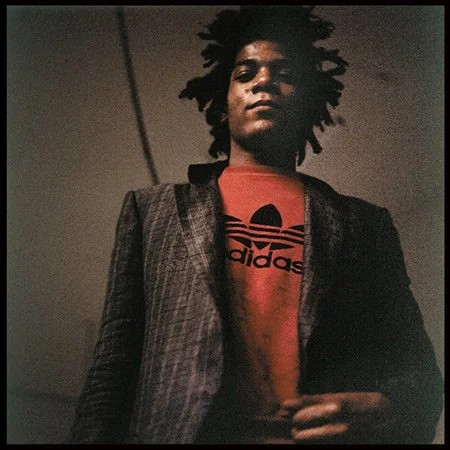
Jean-Michel Basquiat, 1981. Courtesy of Edo Bertoglio
This context corrects a common simplification. Basquiat did not become successful by persuading the art world to embrace a wholly unfamiliar kind of painting. He entered a market that had already developed an appetite for expressive figurative work. His opportunity came from fitting that appetite.
What Made Basquiat’s Painting Style Distinctive
Basquiat fit comfortably within the revival of expressive figurative painting, but two related qualities distinguished him from the artists being promoted alongside him. He was the sole Black artist among the movement’s most heavily promoted international figures, a distinction that generated considerable interest in him among buyers.
He also placed Black figures at the center of many of his paintings. Basquiat was explicit about this choice. “Black people are never portrayed realistically in . . . modern art enough, and I’m glad that I do that,” he told an interviewer. “I use the ‘Black’ as the protagonist because I am Black, and that’s why I use it as the main character in all my paintings.”
It is important, however, not to think of Basquiat as the only significant Black artist working at the time. He was part of a broader generation that included Frank Bowling, Sam Gilliam, David Hammons, Howardena Pindell, Faith Ringgold, Betye Saar, and Jack Whitten, among others. Most are now widely collected and represented in major museum collections. In the early 1980s, however, Basquiat was unusual in being represented by leading galleries, consistently featured in the art press, and promoted within the international market forming around Neo-Expressionism.
Celebrity occurs when who you are and what the world wants converge. Into the booming appetite for highly expressive art stepped the equally expressive Basquiat: a tall, handsome, bisexual, self-taught young Black man who was ambitious, well read, and unapologetically provocative. Sexy and cool, he challenged and charmed the people around him. His personality, appearance, and work made him an ideal figure for the 1980s art boom and a natural fit for Bischofberger’s gallery.
How Basquiat Made His Paintings
As I explain in my biography, Jean-Michel Basquiat: The Making of an Icon, Basquiat was recognized as intellectually gifted at a young age. He absorbed information quickly, retained an extraordinary range of material, and formed connections among ideas that others might not have placed together. Those abilities are essential to understanding how he made his paintings.
The first important feature was his ability to turn accumulated knowledge into visual material. Fueled by an insatiable curiosity, he found source material in history, science, music, popular culture, and the streets around him. Comic books, cereal boxes, and the drawings of Leonardo da Vinci could all find their way into his paintings. Basquiat removed images, phrases, and symbols from their original settings and placed them beside elements with which they had no obvious connection. Rather than rely on conventional pairings or orderly narratives, he created compositions in which disparate ideas collided, overlapped, and acquired new associations. The paintings could be intellectually dense and visually disorienting at the same time.
A second defining feature was the way he combined different artistic media. Drawing was central to his practice, but he rarely made preparatory sketches that he then transferred to canvas. He drew directly on his paintings, pasted original drawings or photocopies onto their surfaces, and continued working over and around them. Drawing, collage, painting, and writing became parts of the same activity, distinguished less by medium than by the scale and surface on which he was working.
His process was also highly improvisational. Basquiat worked swiftly and revised constantly. When dissatisfied, he might scratch through it, mark it with an X, or partially conceal it beneath another layer. Yet he often allowed traces of the earlier idea to remain visible. A word could be crossed out but still be read. A figure could disappear beneath paint without being fully erased. These remnants of earlier decisions gave the paintings an immediacy and vitality, as though the viewer were witnessing the work take shape.
A final influence on his style was his lack of formal art training. Basquiat had not learned to model figures convincingly through light and shadow, construct space through conventional perspective, or render realistic portraits and landscapes. His figures were typically flat and diagrammatic, with bodies and objects reduced to forceful outlines and simplified forms.
Limited technical training, however, should not be confused with limited ability. Basquiat possessed an astute eye for color and composition that complimented his extraordinary store of visual information. Rather than conceal what he could not do conventionally, he developed an approach in which realism was unnecessary. Intense color, abrupt changes in scale, handwritten words, repeated images, and jagged black marks allowed him to create paintings whose complexity came from the relationships among their elements rather than from technical illusionism.
What Did Basquiat Paint About? His Major Subjects and Sources
Basquiat’s distinctive style was matched by an unusually broad range of subject matter. He drew on his own experiences, Black figures he admired, history, and the complicated relationships within his family.
Basquiat’s Personal Experience and Autobiography
Basquiat’s own experiences frequently supplied the starting point. Dustheads, a six-by-seven-foot painting, depicts two figures in lurid colors against a black background. One has raised arms, a blood-red body, and a ghoulish face; beside it stands a skeletal figure with sunken eyes. The title refers to users of angel dust, a highly addictive drug whose effects ranged from euphoria to agitation and desperation. Given Basquiat’s extensive drug use, the painting may contain an autobiographical element, although he left no explanation confirming that interpretation.
Another formative experience was the life-threatening car accident Basquiat suffered when he was seven. During his recovery, his mother gave him a copy of Gray’s Anatomy. Its illustrations became a lasting source for the bones, organs, skulls, and dissected limbs that appeared in many of his works. Their influence can be seen in Masonic Lodge. Against an indigo-blue background, Basquiat drew a human skull from several angles, recalling the anatomical illustrations he had studied. At the center is an eye, while the phrase “PARANOID SCHIZOPHRENIA” appears near the top, with most of its letters scratched out. Because his mother lived with schizophrenia, it is tempting to read the painting as a poignant and intricately coded response to her illness. Basquiat, however, left no explanation confirming that interpretation.
Black Figures and Black Achievement
Black people occupied an especially prominent place in Basquiat’s art. He painted himself repeatedly in works including Portrait of the Artist as a Young Derelict and Self-Portrait as a Heel. He also paid tribute to Black men he admired, including jazz musician Charlie Parker in Charles the First and boxing champion Sugar Ray Robinson in a painting bearing the fighter’s name. In other works, including Obnoxious Liberals, Mitchell Crew, and Irony of Negro Policeman, anonymous Black figures occupy the center of the composition.
History, Slavery, and Colonialism
History provided another rich source of material. Basquiat created numerous paintings that drew on conquest, slavery, trade, and political upheaval across widely separated periods.
One of the most ambitious examples is The Nile, also known as Untitled (History of the Black People). Across its nearly six-by-twelve-foot surface, Basquiat assembled references to Nubia, ancient Egyptian cities, slave ships, enslavement, and modern-day Tennessee. The painting does not present a conventional historical narrative. Instead, it compresses distant places, languages, and periods into a single field of associations.
Other paintings reached across an equally broad historical range. Toussaint L’Ouverture Versus Savonarola invokes the overthrow of oppressive regimes in eighteenth-century Haiti and Renaissance Italy. Notary incorporates references to trade and private property. Speaks for Itself looks toward the Roman Empire and its conquest by the Goths, while Native Carrying Some Guns, Bibles, Amorites on Safari draws on the history and imagery of colonial oppression.
Basquiat’s Parents: Mater and Pater
Basquiat also turned his attention to the people closest to him. In Mater and Pater, monumental portraits named after the Latin words for mother and father, he depicted his parents as naked figures.
Matilde faces the viewer with outstretched arms, her muscular body providing a sense of movement. A circle with radiating lines appears around her head, resembling a halo. Given her passionate Christian beliefs, the image may suggest reverence or deification.
The treatment of Gerard is markedly different. Basquiat gave his father a comic expression and crudely exaggerated genitalia reminiscent of bathroom-wall graffiti. The portrait is irreverent and deliberately unflattering. It is difficult not to connect the contrast between the two paintings to Basquiat’s different relationships with his parents, although the precise intentions behind them remain his own.
Why Basquiat Used Words in His Paintings
Words were not captions added after Basquiat completed an image. They were part of the composition itself. He wrote names, places, historical references, scientific terms, and stray phrases directly onto the surface, usually in the block capitals he had used in his SAMO tags.
The language could identify a figure, connect the painting to a historical event, or label anatomical forms in ways that recalled the medical books Basquiat consulted. But words also worked visually. Their size, placement, and rhythm helped organize the surface, fill an empty space, or pull the viewer’s eye across the painting.
Basquiat also crossed out words while leaving them legible. He explained that doing so made people want to read them. The words in Basquiat’s paintings must therefore be both read and looked at. They carry information, but they also function as visual marks whose meaning and effect depend on where they appear and what surrounds them.
What Does Basquiat’s Crown Mean?
No symbol is more closely associated with Basquiat than the three-point crown. It appears across paintings and drawings, sometimes above a figure, sometimes beside a name, and sometimes as an image in its own right. Basquiat, however, never explained what it meant to him. Claims that the crown represented kingship, artistic greatness, Black heroism, or personal ambition are therefore interpretations, not documented statements of his intent.
As I explain in my biography, the most reliable place to turn to understand what they may mean is with the visual culture Basquiat knew as a teenager. In the New York graffiti scene, artists did not sign their work with their given names. They typically used aliases, often combining a nickname with the number of the street where they lived. Status within the community depended on the quantity and quality of the work a writer produced. Artists at the top of that hierarchy sometimes added a crown to their aliases to signal their standing, while other writers might place a crown above an especially admired piece as a gesture of respect for the creator. In this setting, the crown was not an abstract art-historical symbol. It belonged to a living system of reputation, competition, and recognition that Basquiat understood well.
Al Diaz, Basquiat’s partner in creating the SAMO tags, used the alias Bomb 1 and sometimes added a crown to it. Basquiat therefore knew both the form and its conventional meaning in graffiti culture before choosing to incorporate it into his art.
Lee Quiñones, another important figure in that community, believes Basquiat transformed the convention rather than simply adopting it. Graffiti crowns were generally rendered carefully, without drips or splatter, because they conveyed respect and honor. Basquiat’s crowns, by contrast, were often crude and irregular. Quiñones considers that roughness deliberate. In his view, Basquiat was questioning what kingship represented: accomplishment, privilege, authority, or the exploitation sometimes required to reach the top. “If it was perfect, then he was a servant to the crown,” Quiñones told me. Basquiat, he believed, altered the symbol so that it could question status as well as confer it.
The Ruffians offers an early example. Basquiat covered the background with photocopies of two drawings of cartoon-like figures, then drew three large stick figures over the collaged surface. Each has a colorful, masklike face topped by a roughly rendered three-point crown. The crowns give the figures prominence, but the painting does not tell us whether they are kings, pretenders, heroes, or targets of ridicule.
That uncertainty is not a failure of interpretation. We can trace the crown to graffiti culture, explain how it was conventionally used, and consider informed testimony about how Basquiat altered it. What we cannot do is assume that it carried one fixed meaning wherever it appeared.
How to Look at a Basquiat Painting
A useful way to approach a Basquiat painting is to resist the impulse to decode it immediately. Begin instead with what is actually present on the surface.
First, identify the painting’s basic elements. What figures, words, colors, symbols, and objects appear? Which dominate the composition, and which are easy to overlook? Notice what has been repeated, crossed out, covered over, or left incomplete. These choices can show how Basquiat directed attention and created visual tension.
Next, consider how the painting was made. A pasted drawing, a photocopied image, a handwritten phrase, and a passage of acrylic paint or oil stick may all occupy the same surface. Earlier decisions may remain partly visible beneath later ones. Following these layers can reveal how the painting developed without assuming that every revision carries a hidden symbolic meaning.
Then look for recurring subjects. Does the painting include anatomy, Black protagonists, musicians, family members, or historical references? Seeing an image as part of Basquiat’s broader visual vocabulary can make it more intelligible, but recurrence does not guarantee a fixed meaning.
Finally, separate evidence from inference. Some elements can be traced to identifiable sources, including Gray’s Anatomy, Henry Dreyfuss’s Symbol Sourcebook, historical texts, popular imagery, and graffiti culture. Knowing the source of an image gives interpretation a firmer foundation, but it does not necessarily explain why Basquiat used it in a particular painting.
The most useful question is therefore not “What does this painting mean?” but “What does the evidence in this painting support?” A persuasive interpretation should account for what is visible, what is known about Basquiat’s sources and methods, and how the elements interact within that particular work. It should also acknowledge what remains uncertain.
Basquiat’s paintings do not need to be solved to be enjoyed; they offer more than enough to hold our attention: vivid figures, unexpected words, historical references, visible revisions, and connections among seemingly unrelated ideas. Looking closely at these elements can deepen our appreciation of the work without requiring every symbol to yield a fixed meaning.
Interpretation remains part of the pleasure. The discipline is knowing where the evidence ends and interpretation begins.
Want to Go Deeper into Basquiat’s Story?
This article is drawn from Jean-Michel Basquiat: The Making of an Icon, the first major biography of Basquiat in more than 25 years. Based on more than 100 interviews, court records, family archives, and previously unpublished documents, the book moves beyond familiar myths to offer a fuller account of Basquiat’s life, art, career, and posthumous rise, including new revelations about his childhood, relationships, artistic development, and transformation into a global icon.
About Doug Woodham
Doug Woodham is an economist and art-market adviser whose career has spanned consulting, technology, and the art world. He is Managing Partner of Art Fiduciary Advisors, where he advises collectors and families on financial decisions involving art. He previously served as President of Christie’s Americas and as a Partner at McKinsey & Company.
He holds a Ph.D. in economics from the University of Michigan and is the author of Jean-Michel Basquiat: The Making of an Icon and Art Collecting Today: Market Insights for Everyone Passionate About Art.
