WAS JEAN-MICHEL BASQUIAT JEWISH? THE UNTOLD STORY OF HIS MOTHER'S ANCESTRY
Doug Woodham | May 2026
An interview with Basquiat’s uncle uncovered Jewish roots in his mother’s family, while the Israel Museum’s early embrace of the artist adds a remarkable historical coincidence.
While researching my book Jean-Michel Basquiat: The Making of an Icon, I discovered a previously unknown part of Basquiat’s family history that adds an overlooked dimension to the story of his Puerto Rican heritage.
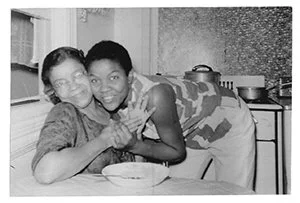
Matilde Andrades Basquiat, right, with her mother, Flora Andrades, in the late 1950s. Courtesy of Reuben Andrades
Accounts of Basquiat’s family have often reduced his parents to a few familiar facts. His Haitian father, Gérard, is typically portrayed as the strict parent with whom Jean-Michel repeatedly clashed. His Puerto Rican mother, Matilde, is remembered principally for encouraging his early interest in art and for the mental illness that later disrupted her life. I wanted to uncover a fuller picture of Matilde, who died in 2008. The door for doing so opened when I located her brother, Reuben Andrades. Reuben, who had been close to both his sister and her son Jean-Michel, had never before been interviewed.
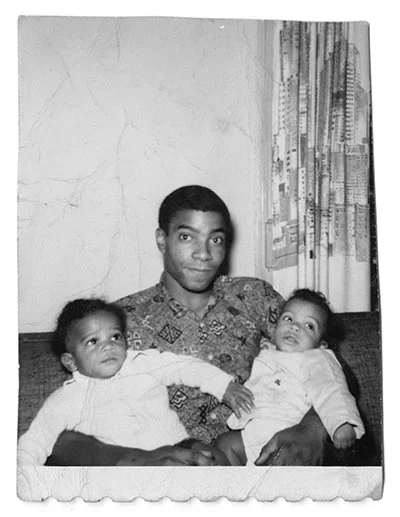
Reuben Andrades with his nephew Jean-Michel Basquiat, at left, and his own son in the Andrades family home in Bushwick, Brooklyn, Courtesy of Reuban Andrades
Reuben and his family had lived with Matilde and Gérard and their son in a multigenerational household in Bushwick that also included Jean-Michel’s maternal grandmother, Flora. Reuben told me that Jewish ancestry ran through both sides of Flora’s family.
Basquiat’s Jewish Ancestry and Puerto Rican Heritage
Jean-Michel’s upbringing was steeped in religion. His maternal grandmother, Flora Andrades, a devout Christian who had immigrated to New York from Puerto Rico, made sure the family regularly worshipped at the First Spanish Presbyterian Church of Brooklyn. Yet according to Reuben, Flora also knew that Jewish ancestry ran through both sides of her family. Her maternal ancestors included Spanish Jews, while her paternal ancestry included both Taíno, Indigenous people of the Caribbean, and Jewish roots.
Flora’s family history reflects a broader pattern in Puerto Rico. During and after the Spanish Inquisition, Sephardic Jews and forced converts left Spain and Portugal for the Caribbean. Over generations, many of their descendants intermarried and became part of predominantly Christian communities. Yet many retained traces of their Jewish ancestry or custom, including observing Shabbat, avoiding shellfish and pork, and observing Yom Kippur, Rosh Hashanah, and Passover. Later waves of immigration established organized Jewish communities on the island, particularly during the twentieth century. This history helps explain how Jewish ancestry could persist within a Puerto Rican family that identified as Christian.
Although Matilde embraced Christianity, her Jewish lineage was known within the family. Gérard Basquiat once mistakenly listed his wife as Jewish on a school enrollment form for Jean-Michel.
So, was Basquiat Jewish? The answer depends on whether the question concerns ancestry, religious law, religious practice, or personal identity. He clearly had Jewish ancestry through his mother’s family. Because traditional Jewish law determines Jewish status through the maternal line, that ancestry carried religious as well as genealogical significance.
But Basquiat was not raised as a practicing Jew and did not publicly identify as Jewish. He later described himself as an atheist. It is unclear how much he knew about his Jewish heritage, though his close relationship with his mother and his inquisitive mind makes it highly likely that he was aware of this strand of his family’s history.
The Israel Museum: The First Museum to Acquire a Basquiat
For a young artist, an acquisition by a major museum is a significant milestone. In late 1982, when Jean-Michel was twenty-one, the Israel Museum in Jerusalem became the first museum in the world to acquire one of his paintings. Suzanne Landau, recently appointed curator of international contemporary art, purchased Agony of the Feet from the Annina Nosei Gallery for $9,000.
Landau had first learned about Basquiat that summer at the Venice Biennale, during an extended conversation with Nosei about the artists she represented. Intrigued, she made a point of visiting the gallery on a trip to New York that November. There she bought Agony of the Feet, the first acquisition of her tenure at the museum.
The painting depicts a disembodied foot alongside a masklike face. Its title may allude to the severe infections Basquiat suffered while living on the streets after leaving home at seventeen. Landau confirmed to me that she knew nothing about Basquiat’s Jewish ancestry when she acquired the painting, making the Israel Museum’s early recognition of him an unexpected historical coincidence.
Two years later, the museum added a second Basquiat painting to its collection. Donated by New York collectors Barbara and Eugene Schwartz, the work depicts one of Basquiat’s monumental boxers. The six-foot-square figure seems to oscillate between triumph and defeat, depending on the viewer’s perspective. The Schwartzes had purchased the painting from the Annina Nosei Gallery in 1981.
Two decades later, the Israel Museum approached Barbara Schwartz for permission to sell the donated painting and use the proceeds to establish an endowment for contemporary art acquisitions. Schwartz, who believed museums should have the flexibility to sell works periodically to strengthen their collections, agreed. On May 15, 2007, the painting sold at Sotheby’s for $14.6 million, then an auction record for Basquiat. The proceeds established the Barbara and Eugene Schwartz Contemporary Art Acquisition Endowment Fund, which has since supported numerous acquisitions of contemporary art.
Want to Go Deeper into Basquiat’s Story?
This article is drawn from Jean-Michel Basquiat: The Making of an Icon, the first major biography of Basquiat in more than 25 years. Based on more than 100 interviews, court records, family archives, and previously unpublished documents, the book moves beyond familiar myths to offer a fuller account of Basquiat’s life, art, career, and posthumous rise, including new revelations about his childhood, relationships, artistic development, and transformation into a global icon.
About Doug Woodham
Doug Woodham is an economist and art-market adviser whose career has spanned consulting, technology, and the art world. He is Managing Partner of Art Fiduciary Advisors, where he advises collectors and families on financial decisions involving art. He previously served as President of Christie’s Americas and as a Partner at McKinsey & Company.
He holds a Ph.D. in economics from the University of Michigan and is the author of Jean-Michel Basquiat: The Making of an Icon and Art Collecting Today: Market Insights for Everyone Passionate About Art.
