HOW THE BASQUIAT ESTATE USED LICENSING TO BUILD A GLOBAL BRAND
Doug Woodham | September 2026
Basquiat’s imagery now appears on everything from sneakers to tequila bottles and Barbie dolls. The deals have generated substantial licensing revenue for his Estate while introducing his work to millions of people and helping strengthen his appeal among a new generation of collectors.
For much of the twentieth century, serious art and mass merchandising belonged to different worlds. Rock stars could sell T-shirts; artists were expected to preserve the rarity and aura of their work.
Keith Haring began to challenge that convention in the 1980s. The Basquiat Estate later pushed it much further, licensing Jean-Michel Basquiat’s imagery across luxury fashion, sneakers and mass-market consumer products while the market for his original works moved in the opposite direction: toward greater scarcity, prestige and value.
That apparent contradiction sits at the center of the Basquiat licensing story. The Estate discovered that making his imagery widely available did not diminish the aura of the original art. It could generate income, expand his cultural reach and, at the same time, make ownership of a Basquiat seem even more exceptional. How that happened is the subject of this article.
Why Fine Artists Once Avoided Licensing and Merchandising
Long before visual artists started to embrace licensing, popular entertainers had discovered its power. In the 1950s, Elvis Presley’s managers put his name and image on sneakers, clothing and even lipstick. Rock bands later made T-shirts, pins and other merchandise a routine part of fan culture, giving admirers an inexpensive way to signal their allegiance. Fine art developed very differently. Books and posters were acceptable; using an artist’s imagery in consumer products was not.
Keith Haring was among the first contemporary artists to challenge that convention. He rose to prominence in the early 1980s with his bold, graphic imagery, often featuring motifs such as a barking dog or a crawling infant. Like Basquiat, he exhibited internationally, mingled with luminaries like Andy Warhol, and danced at the best clubs. As prices for his paintings and drawings rose beyond the reach of most people, he opened the Pop Shop in downtown Manhattan, selling inexpensive products decorated with his instantly recognizable images. The items flew off the shelves, prompting him to open a second shop in Tokyo.
The experiment mattered because it appeared to violate the economics of fine art. Haring was making his imagery more widely available just as his original works were becoming scarcer and more expensive. Yet collectors continued to pay high prices for the art. The Pop Shop offered early evidence that mass accessibility and scarcity at the top of the market did not necessarily work against each other.
How Licensing Helped the Basquiat Estate Keep Its Art

Basquiat with guests at the Dallas Museum of Art, June 1985. Courtesy of Dallas Museum of Art Archives, photo by Andy Hanson
When Basquiat died in 1988 at the age of twenty-seven, his parents inherited 171 paintings and roughly 1,000 drawings by him, along with the copyrights to his work. Those copyrights covered Basquiat’s entire body of work, not just the pieces the Estate owned.
That left the Estate with two very different kinds of assets: a finite inventory of original art and intellectual-property rights that could be licensed repeatedly. It could authorize Basquiat’s imagery for products, packaging, advertising and other commercial uses even when the underlying artwork belonged to someone else. A painting or drawing sold by the Estate, by contrast, was gone for good.
Gerard Basquiat, who managed the estate, was reluctant to sell his son’s work. He believed Jean-Michel’s paintings and drawings would become more valuable over time, which meant every work sold too early carried a potentially large opportunity cost. But keeping the art was expensive. The Estate had to store and insure hundreds of works, pay advisors and legal fees, and cover the other costs of managing a valuable collection. Licensing gave it another source of income to help meet those expenses without selling down the art.
Gerard learned how that model could work partly through lawyers who had advised Keith Haring and later worked with the Keith Haring Foundation. They helped him understand that Basquiat’s copyrights could become a recurring source of revenue.
How the Basquiat Estate Expanded Licensing Through Valentino and Reebok
After some early experimentation, the Estate began to think bigger. In 2006, it licensed Basquiat’s work to Valentino for the fashion house’s fall women’s collection. Fifteen of the runway show’s eighty-one looks incorporated Basquiat imagery, including a sequined blazer that translated one of his skull motifs into an elaborate embroidered design. His work had moved from galleries and museums onto the runway of a major luxury fashion house.

Valentino's Fall/Winter 2006 Ready-to-Wear collection
Three years later came a partnership with Reebok. The fit was more natural. The company already had strong ties to hip-hop through collaborations with Jay-Z, Pharrell and 50 Cent, while Basquiat’s reputation had become closely linked to downtown New York, Black creativity, and street culture. Reebok put his imagery on a line of sneakers. The collaboration proved successful enough to continue for five years.
Together, the two deals showed how widely the Basquiat name could travel. His imagery could appear in luxury fashion and mass-market footwear alike, reaching very different audiences while generating income without the sale of a single work. Licensing was no longer a sideline. It was becoming a business in its own right.
Basquiat Became Something Millions of People Could Own
Basquiat’s imagery soon spread far beyond fashion and footwear. It appeared on clothing from Comme des Garçons, Coach, the Gap and Uniqlo; surfwear from Billabong; cosmetics from Urban Decay; tequila from 1800 Tequila; and even a Black Barbie dressed in Basquiat-inspired clothing and a crown.
The value of these deals went well beyond licensing fees. Very few people could afford a Basquiat painting or drawing, but millions could own something carrying his imagery. Merchandise gave consumers an inexpensive way to enter a cultural world whose original artworks had become prohibitively expensive. What they acquired was more than a reproduction. It was an association with what Basquiat had come to represent: New York, youth, rebellion, Black achievement, artistic ambition, street culture and creative authenticity.
That is the difference between fame and a brand. Fame creates recognition. A brand gives that recognition meanings people want to claim for themselves. Basquiat had become more than famous. He had become a cultural identity people wanted to wear, display and own.
How Much Does the Basquiat Estate Earn From Licensing?
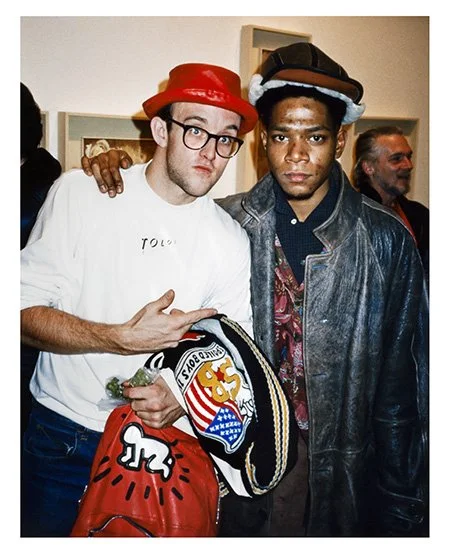
Keith Haring and Basquiat, December 1987. Courtesy of Irving Zucker
The figure is not public. The Estate is privately held and does not disclose its licensing revenues. The Keith Haring Foundation, however, provides a useful benchmark. Its royalty income from copyrights, trademarks and related intellectual property rose from $3.8 million in fiscal 2020 to $8.7 million in 2024.
Haring is likely a conservative benchmark for Basquiat. The Basquiat Estate has licensed his imagery across a wider range of consumer categories, while public interest in Basquiat has consistently exceeded interest in Haring. Over the past decade, Google searches for Basquiat in the United States ran roughly 50 percent higher; on YouTube they were about three times higher.
With a broader licensing footprint and substantially greater public interest, the Basquiat Estate likely earned multiples of the Haring Foundation’s royalty income. Licensing had become a substantial source of revenue in its own right.
How Licensing Helped Expand Basquiat’s Collector Base
Licensing did more than generate revenue. It kept Basquiat unusually visible beyond the art world.
That mattered, especially for younger audiences. His imagery kept resurfacing in fashion, sneakers and other consumer products through collaborations with prominent global brands. Many people became familiar with Basquiat long before they encountered one of his paintings in a museum, gallery or auction room.
I have seen this effect firsthand in conversations with younger collectors. Some first discovered Basquiat through these collaborations. Repeated exposure made them curious about the artist behind the imagery and, for some, eventually interest in owning his work.
The relationship became self-reinforcing. Basquiat’s growing stature in museums and the art market made him more attractive to brands; the collaborations, in turn, exposed him to still larger audiences. Commercial visibility became a form of social proof, reinforcing the sense that Basquiat mattered not only in the art world, but in contemporary culture more broadly.
Licensing therefore did more than monetize Basquiat’s fame. It helped turn cultural familiarity into collector interest.
Would Basquiat Have Approved?
It is one of the questions I am asked most often: what would Basquiat have thought about seeing his art on sneakers, clothing, tequila bottles and Barbie dolls? He probably would have been pleased.
Basquiat was intensely ambitious and cared deeply about his standing as an artist. He wanted recognition, paid close attention to how he was perceived, and saw commercial success as one measure of whether the art world was taking him seriously. Through Andy Warhol and Keith Haring, he had also seen that artistic importance and commercial visibility did not have to be opposites.
Whether he would have approved of every individual licensing deal is impossible to know. But the larger outcome seems consistent with his ambitions. Licensing carried his name and imagery far beyond museums, galleries and auction houses without diminishing the scarcity or prestige of the original works. Millions of people can own something bearing his imagery. Almost no one can own a Basquiat.
Want to Go Deeper into Basquiat’s Story?
This article is drawn from Jean-Michel Basquiat: The Making of an Icon, the first major biography of Basquiat in more than 25 years. Based on more than 100 interviews, court records, family archives, and previously unpublished documents, the book moves beyond familiar myths to offer a fuller account of Basquiat’s life, art, career, and posthumous rise, including new revelations about his childhood, relationships, artistic development, and transformation into a global icon.
About Doug Woodham
Doug Woodham is an economist and art-market adviser whose career has spanned consulting, technology, and the art world. He is Managing Partner of Art Fiduciary Advisors, where he advises collectors and families on financial decisions involving art. He previously served as President of Christie’s Americas and as a Partner at McKinsey & Company.
He holds a Ph.D. in economics from the University of Michigan and is the author of Jean-Michel Basquiat: The Making of an Icon and Art Collecting Today: Market Insights for Everyone Passionate About Art.
