HOW U2 AND OTHER PROMINENT CREATIVES HELPED BUILD BASQUIAT’S REPUTATION
Doug Woodham | August 2026
In the 1990s, U2, David Bowie, Lars Ulrich, Gianni Versace, and other prominent creatives embraced Basquiat. Because their own reputations rested on originality and creative achievement, their support helped validate Basquiat as one of the defining creative figures of his generation.
Basquiat was a cool denizen of New York’s Downtown scene, but the collectors who bought his work during his lifetime were surprisingly square. Business leaders, doctors, and lawyers adorned their walls with the art of this hip young Black man. They gave Basquiat something every artist needs: a market. But after his death in 1988, a different kind of collector began gravitating toward his work.
Rock stars, fashion designers, and actors started buying Basquiat. Unlike the wealthy, but largely anonymous collectors who had supported him earlier, these were highly visible figures whose own reputations rested on originality and creative achievement. Basquiat’s reputation started to grow anew because people who possessed enormous creative credibility recognized him as one of their own. The first, and most revealing example, began with Adam Clayton, the bass guitarist for U2.
How U2 Discovered Basquiat
By the beginning of the 1990s, U2 had gone from four Dublin teenagers to become one of the biggest bands in the world. Clayton had spent ten years inside what he later described to me as an “amazing U2 bubble”: album after album, tour after tour, with little time to look beyond the band.
Then something unusual happened. U2 had finished Achtung Baby, an album they would soon take on tour, but Clayton looked at the calendar and saw something he had not had in years: a six-month stretch in which he could do whatever he wanted. He wanted to go somewhere that would stimulate and excite him. He chose New York. “I was obsessed with New York,” he recalled, because so much of the music that had shaped him had come out of the city: Patti Smith, Television, Blondie, Talking Heads, Iggy Pop, Richard Hell and the Voidoids.
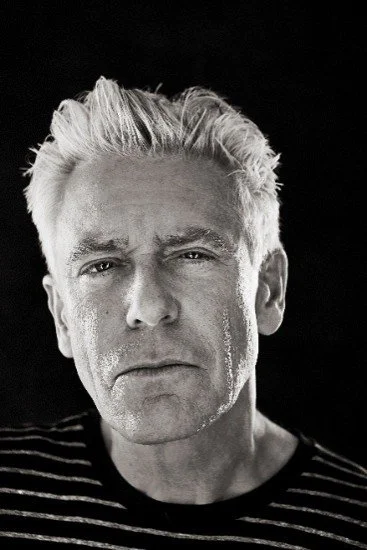
Adam Clayton, 2016. Courtesy of Sam Jones
U2 had played New York many times, but Clayton’s experience of the city was compressed into a few feverish days at a time. The band would arrive, perform, spend nights in clubs, encounter a whirlwind of people, and leave again. He knew the energy of New York without feeling that he understood the place. This time he wanted to stay. “I was going to move to New York and try to understand the place,” he told me. That decision helped open a door into contemporary art.
Catherine Owens, an Irish artist friend living in New York, began taking Clayton to galleries and artists’ studios. He was intrigued by artists close to his own age, particularly the graffiti artists whose work seemed to carry some of the same energy he associated with music. “These were my people,” he remembered thinking, “in terms of their expressions and what they were trying to say.” Owens eventually introduced him to Basquiat’s work. Her selling point was hard to resist: Basquiat, she told Clayton, was their age and was “the Jimi Hendrix of painting.” He had gone to the clubs, painted in Comme des Garçons suits, and made work with an intensity that seemed inseparable from the brevity of his career.
Clayton knew his name, but not much more. U2 had spent time at Area and other Downtown clubs when the band came through New York, and Basquiat was likely to have been in the same rooms. But U2’s attention then had been elsewhere: hip-hop, Fab 5 Freddy, Keith Haring, the constant discovery of new sounds and scenes. “We didn’t brush up against Jean-Michel in quite that way,” Clayton said. Now he began looking closely.
The more Basquiats he saw, the more convinced he became that there was something special about them. Clayton responded to qualities he understood instinctively as a musician: rhythm, improvisation, and raw energy. “With Jean-Michel’s work,” he recalled, “there was always the music, there was always the street.”
Why U2 Bought a Basquiat
Clayton had the means to buy art, but he was not an impulsive collector. He spent time at two New York galleries deeply involved with Basquiat’s work, the Robert Miller Gallery and the Tony Shafrazi Gallery, looking at many paintings and trying to understand what distinguished the best ones. He was soon looking for recurring elements: an early date, a head or masklike figure, words, a crown, and the kind of color and brushwork that gave the painting kinetic energy.
Eventually Robert Miller showed him Untitled (Pecho/Oreja). The six-foot-square painting had many of the qualities Clayton had learned to value. A masklike face dominates the composition. Around it are scattered words and marks, a three-point crown, and the restless brushwork of an artist who was only twenty-two when he made it. Clayton loved the painting. He was less certain about the price.
Coming from one creative industry and entering another, he found the art market bewildering. He could recognize the power of imagery but still wonder how the monetary values attached to artworks had been determined. Clayton was being asked to pay a substantial sum for an artist whose reputation, while established within the art world, had not yet spread much beyond it.
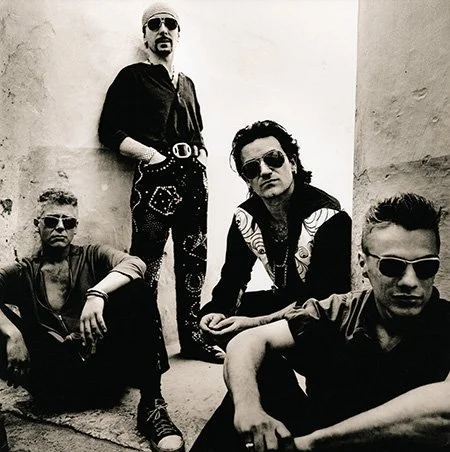
U2 in Tangier, Morocco, around the time they bought the Basquiat painting, 1991. Courtesy of Anton Corbun
Rather than splurge on the painting himself, Clayton decided to see whether Bono, Edge, and Larry Mullen would go in on it with him. He got in touch with his band mates and made what even he knew sounded like a slightly mad proposal: Basquiat was going to become a very significant artist, Clayton had found the painting to buy, and the four of them would not regret owning it together. His bandmates knew almost nothing about Basquiat, but they knew Clayton. “We don’t know anything about this,” he remembered their reaction being, “but we trust our guy.”
What followed was less a considered art-market decision than a leap of creative instinct. The band responded to Basquiat emotionally. The work felt “young, punk, and pure energy.” They did not need a lecture on art history to understand that. They recognized the attitude, the urgency, and the refusal to behave conventionally. In that sense, they were responding to Basquiat as fellow creatives before they were responding to him as collectors.
How U2’s Basquiat Became an Endorsement
U2 shipped the Basquiat to Dublin and gave it pride of place in the band’s recording studio. But this was not simply a room where they dropped in occasionally to work on songs. It was U2’s headquarters, the place where they spent much of their working lives and where a steady stream of record executives, business leaders, musicians, designers, artists, and other creative figures passed through.
The painting hung in a large dining area where meetings took place and people naturally gathered. It was difficult to miss. Over the years, thousands of visitors saw it, many of them exactly the sort of people likely to be intrigued by Basquiat and, in some cases, wealthy enough to buy his work themselves. For the Robert Miller Gallery and the Basquiat Estate, it was priceless placement.
Anyone encountering the Basquiat there was seeing him in an unusually flattering setting. This was not a dealer standing in a gallery explaining why an artist mattered. One of the most famous bands in the world had chosen a major Basquiat to hang at the center of its creative life. U2’s enthusiasm for the painting became an endorsement without anyone needing to call it one.
Clayton understood that. He suspected the commercial side of Robert Miller’s brain understood it too. But he also thought Miller would have been delighted by something less calculating: the idea that a great painting by Basquiat had found its way into the world of musicians. “He probably felt it’s a great union of visual artists and music artists,” Clayton recalled. “He would have liked the romance of it.”
The Basquiat in U2’s Pension Fund
There was another important twist to the story. U2 bought the Basquiat through their Irish pension plan. At the time, a newly introduced retirement scheme allowed people to put money not only into stocks and bonds but also into art. U2 used the plan to acquire Untitled (Pecho/Oreja), the only painting the four band members ever bought together. So what began as Clayton’s conviction about Basquiat became, somewhat improbably, a shared retirement investment.
Years later, the arrangement turned against them. Irish pension rules changed, and the painting could no longer stay in the account. The vehicle that had helped U2 buy the Basquiat now forced the band to sell it. “It was a funny thing,” Clayton told me, “that the vehicle that allowed us to buy the painting in the first place was also the vehicle that created a situation where we had to let it go.”
In July 2008, Untitled (Pecho/Oreja) went to Sotheby’s. After spirited bidding, it sold for $10.1 million. The pension-plan detail is irresistible because it makes the story feel almost absurd: U2, Basquiat, and retirement planning somehow ending up in the same sentence.
Bowie, Metallica, Versace, and Depp Embraced Basquiat
U2 was not alone for long. Other prominent creatives followed, included David Bowie, Lars Ulrich, Gianni Versace, and Johnny Depp. David Bowie began collecting art seriously in the early 1990s, with tastes that ranged from Old Masters to contemporary African art. In 1995, he bought his first Basquiat at auction. Five months later, he bought another. This time it was Air Power, a far more commanding work, which Bowie acquired for $120,144. One Basquiat, apparently, had not been enough.
Lars Ulrich, the drummer and co-founder of Metallica, came to Basquiat by a different route. By the mid-1990s, he had already assembled a serious collection of twentieth-century art, particularly works associated with the CoBrA movement and by Jean Dubuffet. He liked to study artists closely and pursue works he considered especially strong. By the end of the decade, he owned four major Basquiats, including Untitled (Boxer) and Profit I. The attraction was not difficult to understand. Basquiat’s work had something of the punk, theatrical, and performative energy that Ulrich knew from heavy metal.
By then, the appeal was spreading beyond musicians. Gianni Versace bought a Basquiat painting and four Collaboration works Basquiat had made with Andy Warhol in 1996, when his fashion business was thriving and on the verge of going public via an IPO. Johnny Depp also became a collector and relished the way Basquiat could divide people. Viewers, he wrote, tended either to love the work passionately or despise it, “a very difficult result to achieve in any art form.”
Taken together, these were not simply stories about celebrities with enough money to buy expensive paintings. Bowie and Ulrich were serious collectors. Versace had built one of the world’s most influential fashion businesses. Depp had made a career out of playing characters who rarely fit comfortably within convention. Each brought a reputation for originality and creative judgment of his own. Their interest gave Basquiat something different from the early support he had received from wealthy but anonymous collectors. People who had themselves created influential work saw something in him that they recognized.
By the end of the 1990s, a remarkable group of musicians, designers, and actors had gathered around Basquiat’s reputation. This did not yet make him a mass-cultural figure, but it helped move Basquiat into a cultural world much larger than contemporary art.
Want to Go Deeper into Basquiat’s Story?
This article is drawn from Jean-Michel Basquiat: The Making of an Icon, the first major biography of Basquiat in more than 25 years. Based on more than 100 interviews, court records, family archives, and previously unpublished documents, the book moves beyond familiar myths to offer a fuller account of Basquiat’s life, art, career, and posthumous rise, including new revelations about his childhood, relationships, artistic development, and transformation into a global icon.
About Doug Woodham
Doug Woodham is an economist and art-market adviser whose career has spanned consulting, technology, and the art world. He is Managing Partner of Art Fiduciary Advisors, where he advises collectors and families on financial decisions involving art. He previously served as President of Christie’s Americas and as a Partner at McKinsey & Company.
He holds a Ph.D. in economics from the University of Michigan and is the author of Jean-Michel Basquiat: The Making of an Icon and Art Collecting Today: Market Insights for Everyone Passionate About Art.
