
Doug Woodham | November 2026
Gérard Basquiat spent years struggling to understand his rebellious son. Drawing on my original interviews and previously unpublished estate records, this article reveals unexpected dimensions of their relationship and how Gérard transformed a financially troubled estate into an extraordinary artistic fortune.
In the mid-1980s, shortly after relocating his Factory to East Thirty-third Street in Manhattan, Andy Warhol welcomed an unusual visitor: Gérard Basquiat, the father of Jean-Michel Basquiat. A Haitian immigrant who had built a successful career as an accountant, Gérard was a conservative, impeccably dressed man who had struggled for years to understand his rebellious son. Warhol, in contrast, had built his career celebrating the unconventional.
The lunch, arranged by Jean-Michel’s then girlfriend, Paige Powell, brought together two seemingly dissimilar men who hit it off. Jean-Michel was not present. Warhol had purchased the five-story building, a decommissioned Con Edison substation near Madison Avenue, in 1981 and spent the next few years transforming it into his studio, offices, and the headquarters of Interview magazine. “Gérard really appreciated meeting Andy,” recalled Powell, who joined them for lunch, “and seeing that he owned this huge midtown office space. I think this was when Gérard realized the financial success Andy had achieved as an artist.” An accomplished businessman and property owner himself, Gérard could appreciate what Warhol had achieved. Warhol had attained the kind of professional and financial success Gérard had long envisioned for his son, but in a profession Gérard had discouraged Jean-Michel from pursuing.
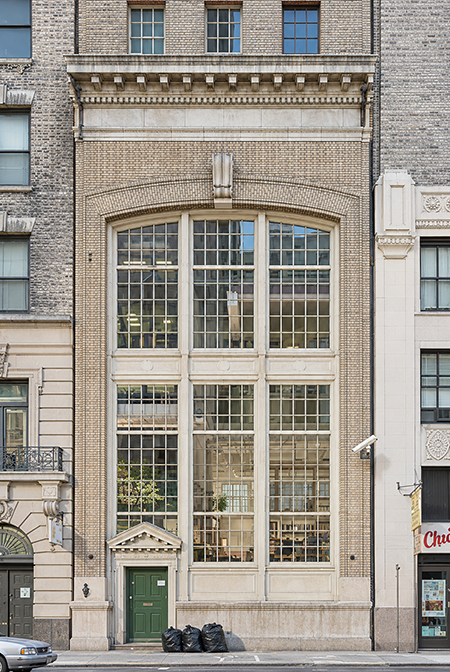
Warhol's Factory located at 22 East 33rd Street (since demolished)
Not long after their first meeting, Warhol was a guest in Gérard’s Brooklyn brownstone. Gérard hosted a small dinner party in February 1985 to celebrate Jean-Michel’s appearance on the cover of The New York Times Magazine. Among those gathered around the table were Warhol, Powell, and several members of the Basquiat family. “Jean-Michel was really happy to be surrounded by the people who loved him,” Powell recalled in an interview for my book. “His family was so proud of him. It was a beautiful evening.”
Three and a half years later, Jean-Michel would be dead. In one of the great ironies of the artist’s life, the father who had once wanted him to pursue a different career would devote much of the next twenty-five years to protecting his work and building his reputation.
Drawing on interviews with people who knew Gérard well, court records, and estate tax returns I obtained while researching my biography of Jean-Michel Basquiat, this article examines the complicated relationship between father and son, how Gérard transformed a financially troubled estate into one of extraordinary value, and how his efforts to protect his son influenced the world's understanding of the artist and his work.
Gérard Basquiat: The Immigrant Father
Gérard Basquiat immigrated to the United States from Haiti in 1955, leaving behind the privileged circumstances in which he had grown up. Four years later, he married Matilde Andrades, an attractive, independent-minded woman of Puerto Rican descent. It was her second marriage and his first. Given the traditional, patriarchal nature of Haitian culture, Gérard's choice of a wife was somewhat unconventional.
The young couple established themselves in a bustling multigenerational household owned by Matilde's parents on Covert Street in Bushwick, Brooklyn. Jean-Michel spent his earliest years surrounded by grandparents, aunts, uncles, and cousins. While Matilde eventually set aside her career ambitions to nurture her gifted son, Gérard worked during the day and pursued an accounting degree at City College at night. Within a few years, they purchased a brownstone in East Flatbush and enrolled Jean-Michel at Saint Ann's, a prestigious private school in Brooklyn Heights.
The comfortable life Gérard and Matilde were building came apart when Jean-Michel was still a young boy. Suspecting Gérard of infidelity, Matilde confronted him and attacked him with a hammer, injuring his legs. Gérard left the family home, returning only sporadically. Although the Andrades family rallied around Matilde, the stress became overwhelming. She suffered a nervous breakdown and was hospitalized for several months.
As her release from the hospital approached, Matilde made a decision that would profoundly affect Jean-Michel’s childhood. She told her family that she didn't want her children to lack for anything but that men ruled the world. Concerned that Gérard might drift away emotionally and financially if she kept the children, she asked him to raise them. Gérard agreed. Matilde returned to her parents’ home on Covert Street without her children. In my companion article about Matilde Basquiat, I explore the circumstances surrounding her decision and its lasting impact on Jean-Michel.
Gérard now faced the dual responsibilities of raising his three children with Matilde and advancing his career. He was working as an accountant at Macmillan, a diversified media company with interests in publishing, film, and education. He purchased a brownstone in Boerum Hill, a rapidly gentrifying Brooklyn neighborhood, which had the added benefit of making it easier for Jean-Michel to visit his mother in Bushwick, Brooklyn. A significant career opportunity soon arose when Gérard was offered the position of financial controller for the Latin American division of Berlitz, Macmillan's language-training subsidiary. In March 1974, Gérard and his three children relocated to San Juan, Puerto Rico.
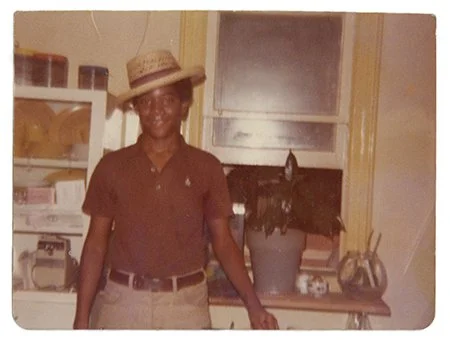
Jean-Michel during a clandestine trip home to see his mother in Brooklyn while he was living temporarily in Puerto Rico, 1975.
It was there that Gérard began to lose his grip on his eldest child. School records reveal the speed of Jean-Michel's unraveling. By the end of ninth grade, he had failed Spanish, Latin American History, Science, and Algebra, passing only Creative Writing. He frequently skipped school, ran away from home, and immersed himself in San Juan's nightlife. On one occasion, he clandestinely returned to New York to see his mother.
When the family moved back to Brooklyn two years later, Jean-Michel was fifteen, wild and increasingly uncontrollable. Over the next eighteen months, relations between father and son grew increasingly strained. After dropping out of high school, Jean-Michel spent much of his time idle and stoned. For Gérard, who had worked so hard to build a life in the United States, it was maddening to watch his son squander the opportunities he had provided. Jean-Michel, however, saw his father as an authoritarian menace who belittled and diminished him.
In the summer of 1978, at the age of seventeen, Jean-Michel left home. He spent nights on the streets, in homeless shelters, and on the couches of people he barely knew. Within a few years, however, he would be selling paintings for thousands of dollars and mingling with some of the most celebrated figures in the international art world. His newfound success would change the dynamics of his relationship with his father.
An Uneasy Reconciliation
By the fall of 1981, when Jean-Michel's paintings were featured in a group exhibition at Annina Nosei's SoHo gallery, Gérard had reentered his son's life. Jean-Michel invited his father to the opening to share in his newfound success. In a wonderfully incongruous scene, Gérard and his longtime girlfriend, Nora Fitzpatrick, arrived early at the gallery, having come directly from their tennis club dressed in their tennis whites.
Some of Jean-Michel's resentments toward his father clearly lingered. Among the more unusual paintings he made were two enormous portraits of his parents, titled Mater and Pater, the Latin words for mother and father. In an extraordinary departure from artistic convention, he depicted both parents naked. While he bestowed a halo on his mother, his depiction of Gérard was decidedly less reverential. With a goofy expression on his face and crudely rendered genitalia reminiscent of bathroom-wall graffiti, Gérard was made an object of ridicule.
Paige Powell, who began dating Jean-Michel in 1983, got to know Gérard well. She saw him as the embodiment of an immigrant success story. In addition to his Brooklyn brownstone, Gérard owned a nearby shop selling home goods and a rental property on Manhattan's Upper West Side. “He had a quiet grand manner about him,” she recalled. “He was very formal in both his demeanor and how he dressed.”
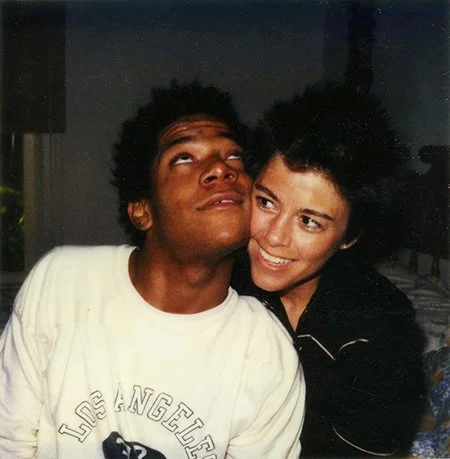
Basquiat and Paige Powell, vacationing in Hana, Hawaii, February 1984.
Jean-Michel often confided in Powell about his difficult upbringing. Yet what she witnessed firsthand was a more complicated relationship than the one Jean-Michel described. “Many of Basquiat’s downtown friends were under the impression that he had this cruel father,” she explained. “But part of the problem was that Jean-Michel was extremely experimental, while his father was a very straight, conservative man.”
What particularly struck Powell was how much Gérard's opinion mattered to Jean-Michel. Despite years of conflict, he retained considerable respect for his father and sought his approval. Their time together could be filled with laughter and conversation, but the two men also delighted in provoking each other. During a vacation in Hawaii with Gérard, Jean-Michel, and Nora, Powell recalled how father and son fiercely competed over everything, from tennis scores to dinner choices.
The dinner Gérard hosted in February 1985 to celebrate his son's success came at a time when Powell was growing increasingly concerned about Jean-Michel's drug addiction. After two exhausting years of witnessing his attempts to get clean followed by relapses, she reached her breaking point. A few months after the celebratory dinner, she ended their relationship.
Concerned about Jean-Michel's welfare, Powell arranged to meet Gérard to tell him in no uncertain terms about his son's drug habits. “I’m not involved anymore in any way with Jean-Michel,” she told Gérard, “so it is important for you to understand his drug habits because he needs your help. You need to talk to him about it.” Gérard agreed but insisted that Powell tell Jean-Michel about their conversation. “He kept saying, ‘You have to tell him that I know. You need to tell him that you told me everything.’” Powell resisted, believing that she had done her duty by bringing the severity of Jean-Michel's addiction to his father's attention. But Gérard persisted, repeatedly calling her over the next few days until she relented.
When Powell went to see Jean-Michel at his Great Jones Street loft and told him about her conversation with Gérard, he became enraged. He hurled a glass vase at her as she fled down the stairs, injuring her when it shattered against a nearby wall. Later that evening, Powell spoke with Warhol, who told her that Jean-Michel had called him shortly after the incident to express how awful he felt. After relaying this, Warhol offered Powell some advice: “Never, ever get involved in family affairs.”
What Gérard subsequently said to his son about his drug addiction is unknown. Despite Jean-Michel’s periodic efforts to get clean, his addiction continued to take a toll. On August 12, 1988, he died of a heroin overdose at the age of twenty-seven. Like many parents who lose a child to addiction, Gérard was left to grapple not only with his grief but also with questions about what he might have done differently.
Inheriting the Basquiat Estate
Shortly after learning of Jean-Michel's death, Powell called Gérard to offer her condolences. She found him devastated but also confronting an emergency. “I need your help, I need your help,” Gérard pleaded. “People have been going in and out of his place all day, taking artwork and removing other stuff from his house.” Powell urged him to get a locksmith to secure the Great Jones Street loft. Through her friendship with the artist Francesco Clemente and his wife, Alba, she also helped Gérard find an experienced art-world attorney, Michael Stout.
As Gérard and Stout began the arduous task of determining what Jean-Michel owned and owed, they made an important discovery. Jean-Michel had held back a substantial portion of his artistic output. Tucked away in storage facilities and his loft were 171 paintings and 917 drawings, representing nearly 20 percent of the paintings and approximately half of the drawings he had made during his brief career. He had also amassed an impressive collection of works by Andy Warhol, acquired as gifts or through exchanges of artwork.
Jean-Michel Basquiat, however, had died without a will, leaving no instructions about what should happen to his artwork or who should inherit his estate. Under New York State law, his estranged parents, Gérard and Matilde, would inherit his estate in equal shares. Matilde agreed to have Gérard appointed to administer it.
Estate tax returns often reveal hidden truths, and Jean-Michel's, filed with the IRS on May 11, 1989, is no exception. I obtained a copy while researching my biography, Jean-Michel Basquiat: The Making of an Icon. It reveals the magnitude of the financial problems Gérard faced. Although Jean-Michel had earned substantial sums as an artist, he had never filed income tax returns. The estate would eventually pay nearly half a million dollars in delinquent federal, state, and local income taxes. Substantial estate taxes were also coming due. Yet the estate had only $32,957 in readily available cash. Jean-Michel had no investment accounts, real estate holdings, or other valuables of consequence, such as cars, jewelry, or furniture.
Jean-Michel had a penchant for extravagant spending, devoting nearly all his earnings to sustaining his lavish lifestyle. He traveled constantly, staying at the finest hotels and resorts. For extended periods, he maintained a room at the Ritz-Carlton in New York as a refuge from his Great Jones Street loft. Generous with friends, he often gave them cash or gifts. His drug habits also consumed a significant portion of his earnings.
Gérard made a fateful decision. Rather than immediately selling works by his son to raise money, he consigned works by other artists to Christie's, most notably pieces by Andy Warhol. It was the beginning of what would become a decades-long effort to retain as much of Jean-Michel's work as possible.
Gérard's financial problems were soon compounded by a series of lawsuits. Jean-Michel's last girlfriend, Kelle Inman, claimed ownership of artworks consigned to Christie's. His last dealer, Vrej Baghoomian, filed a $40 million lawsuit claiming exclusive rights to sell the works by Jean-Michel owned by the estate. Court-imposed restrictions on the sale of artworks and the disbursement of auction proceeds left Gérard struggling to meet the estate's mounting expenses. By the end of 1989, he had petitioned the court for permission to borrow $500,000 against the estate's assets and taken a leave of absence from his accounting job.
“People took advantage of Jean Michel,” Gérard told a reporter at the time. “He was very young and had a loose lifestyle, and the minute he died all these people came up with groundless claims. Aside from the tremendous expense, the litigation is an emotional burden and very time-consuming.”
Gérard had lost his son. He was now embroiled in a battle to retain control of his son's artistic legacy.
Building an Artistic Legacy
One of Gérard's earliest decisions as administrator of his son's estate revealed how he wanted Jean-Michel to be remembered. Although several of Jean-Michel's former dealers vied to represent the estate, Gérard chose to forge a new path. He approached the Robert Miller Gallery, which had never represented his son. John Cheim, a senior director at the gallery, recalled Gérard's desire to make a clean break with the downtown art scene. “He did not want Jean-Michel’s legacy to be associated with Keith Haring, graffiti art, or what he perceived to be downtown decadence,” Cheim told me. “He wanted a bit of uptown elegance to help separate his son from his past excesses.”
Gérard also harbored considerable resentment toward the museum establishment. Despite Jean-Michel's commercial success during his lifetime, many museum curators remained skeptical of his artistic significance. When Herb and Lenore Schorr, two of Jean-Michel's most important early collectors, offered to donate major paintings to museums after his death, their gifts were unceremoniously rejected. “It was a stinging rebuke that Gérard never forgot,” Cheim recalled.
Meanwhile, Gérard was proving to be a formidable legal adversary. His protracted battle with Baghoomian ended in victory in late 1991 when the presiding judge dismissed the dealer's claims. A few months later, Gérard won a copyright infringement lawsuit against Baghoomian for the unauthorized reproduction of Jean-Michel's work in the lavish catalog accompanying the dealer's posthumous Basquiat exhibition.
Another battle loomed, this time with the Internal Revenue Service. Three years after filing Jean-Michel's estate tax return, Gérard received an unwelcome certified letter. The IRS had rejected his aggressive valuation of the hundreds of artworks held by the estate and given him two options: pay approximately $1 million in additional taxes within ninety days or challenge the assessment in the U.S. Tax Court. Gérard chose the latter. Shortly before the case was scheduled to go to trial, the parties reached a settlement requiring the estate to pay just $81,685 in additional taxes. Gérard's tenacity had paid off.
By the mid-1990s, after nearly seven years of managing his son's estate, Gérard was well schooled in the inner workings of the art world. The more he learned, the more determined he became to retain Jean-Michel's work. “He really didn’t want to sell very much,” Cheim recalled. “He would sell one painting here and there to support the Estate, maybe some drawings. He wasn’t greedy at all. He didn’t want to make a gazillion dollars. He just wanted his lifestyle and to support his son’s legacy and sell enough to keep that going.”
But ownership of a substantial portion of Jean-Michel's artistic output was only one source of Gérard's influence. The estate also owned the copyrights to Jean-Michel's paintings and drawings, including works that had long since passed into the hands of collectors and museums. Gérard increasingly appreciated the considerable leverage this gave him in his dealings with galleries, museums, and publishers.
With his major legal battles behind him and little inclination to sell his son's work, Gérard dispensed with the services of the Robert Miller Gallery and began operating independently. If he needed to sell a painting, he could approach whichever gallery or auction house offered the most favorable terms. If a museum wanted to organize a retrospective, its curators could negotiate directly with him for the right to reproduce images of Jean-Michel's work. Through the authentication committee he had established, staffed by dealers and curators familiar with his son's work, Gérard also kept abreast of developments in the market.
Less than a decade after Jean-Michel's death, the accountant who had once discouraged his son from becoming an artist had become a powerful figure in the international art world.
Promoting the Art, Protecting the Artist
Two developments in the second half of the 1990s helped propel Jean-Michel's fame far beyond the confines of the art world. Both occurred over Gérard's objections.
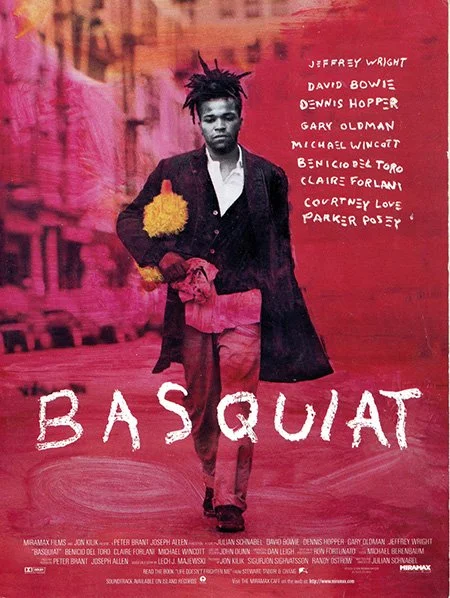
Poster used to promote Basquiat
The first was the release in 1996 of Basquiat, a movie directed by the artist Julian Schnabel and largely financed by Peter Brant, an avid Basquiat collector. Despite his friendship with Brant, Gérard vehemently opposed the project. “He was always against it,” Brant told me. “He didn’t want us to do it, even though we were friends. Any mention of drugs or anything like that, he would not approve of it.” When Gérard refused to grant permission to reproduce Jean-Michel's artwork in the movie, the resourceful Schnabel made the faux-Basquiat paintings seen in the film.
Two years later, the journalist Phoebe Hoban published Basquiat: A Quick Killing in Art, an unauthorized biography that chronicled Jean-Michel's extraordinary rise to fame and descent into drug addiction. “Hoban leaves little to the imagination,” observed a reviewer in The New York Times, likening the book's vignettes to pulp fiction. For Gérard, reading page after page of sordid details about his son's sex life and drug use was painful. A few months after the book's publication, he sued Hoban and her publisher, not for defamation or invasion of privacy but for copyright infringement. The parties eventually reached a confidential settlement.
Gérard's control of the copyrights to Jean-Michel's artwork also gave him considerable influence over what museum curators wrote about his son. Before granting permission to reproduce artwork images in exhibition catalogs, Gérard wanted to review the accompanying essays. Curators who worked with him soon learned which subjects would provoke his ire: Jean-Michel's struggles with addiction, his bisexuality, and his traumatic childhood. As I explore in my companion article, Editing the Past: How Gérard Basquiat Controlled His Son’s Story, Gérard's efforts to shape the narrative about his son had consequences for how his art was interpreted.
There was, however, another side to Gérard's use of the estate's copyrights. He recognized the enormous potential of licensing images of Jean-Michel's artwork for use on clothing, accessories, and other consumer products. These ventures generated royalty income for the estate while introducing Jean-Michel's imagery to millions of people who might never encounter one of his paintings in a museum or gallery. In doing so, as I explore in my article about the estate's licensing activities, Gérard laid the groundwork for Jean-Michel's emergence as a global brand, a level of cultural prominence achieved by remarkably few visual artists.
The Basquiat Estate: An Extraordinary Inheritance
When Gérard Basquiat died in July 2013, nearly twenty-five years after his son's death, the artworks he had worked so hard to retain had appreciated enormously in value. Estate tax records reveal the magnitude of that appreciation. In 1989, Christie's had appraised the artworks in Jean-Michel's estate that he himself had created at $3.2 million. Following Gérard's death, the value of the Jean-Michel Basquiat estate's art holdings was established at $337.3 million in an agreement with the Internal Revenue Service. Despite periodic sales to support the estate, the value of its art holdings had increased more than a hundredfold.
Unlike his son and former wife, both of whom died without wills, Gérard had made provisions for the disposition of his wealth. His most valuable asset was his 75 percent interest in the Jean-Michel Basquiat estate. His two daughters, Lisane and Jeanine, had inherited the remaining 25 percent following their mother's death in 2008. In his will, Gérard stipulated that his interest be divided equally among his two daughters and Nora Fitzpatrick, his companion of many decades.
Shortly after Gérard's death, Nora did something extraordinary. She declined her inheritance, allowing it to pass instead to Jean-Michel's two sisters. Based on the value of the estate's artwork, Nora was relinquishing an inheritance worth tens of millions of dollars in their favor. It was a remarkably generous act that left the sisters with complete ownership and control of their brother's estate.
Much of Jean-Michel's posthumous success can be attributed to a small group of devoted collectors, dealers, and museum curators who championed his work when much of the art establishment questioned his significance. But Gérard played a particularly consequential role. His determination to retain his son's artwork, his tenacity in defending the estate, and his ingenuity in exploiting its intellectual property rights helped create one of the most valuable artist estates in the world.
Yet Gérard's control of those intellectual property rights also enabled him to shape the story of his son's life. As I explore in Editing the Past: How Gérard Basquiat Controlled His Son’s Story, his desire to protect Jean-Michel led him to discourage discussion of some of the very experiences that had shaped him as an artist. The paternal impulses that had been the source of so much friction between father and son during Jean-Michel's lifetime continued to influence how the artist was understood long after his death.
When Gérard met Andy Warhol for lunch in the mid-1980s, he was impressed by the financial success Warhol had achieved as an artist. It is hard to imagine that Gérard could have foreseen the stature his own son would eventually attain, or the extraordinary role he himself would play in bringing it about.
Want to Go Deeper into Basquiat’s Story?
This article is drawn from Jean-Michel Basquiat: The Making of an Icon, the first major biography of Basquiat in more than 25 years. Based on more than 100 interviews, court records, family archives, and previously unpublished documents, the book moves beyond familiar myths to offer a fuller account of Basquiat’s life, art, career, and posthumous rise, including new revelations about his childhood, relationships, artistic development, and transformation into a global icon.
About Doug Woodham
Doug Woodham is an economist and art-market adviser whose career has spanned consulting, technology, and the art world. He is Managing Partner of Art Fiduciary Advisors, where he advises collectors and families on financial decisions involving art. He previously served as President of Christie’s Americas and as a Partner at McKinsey & Company.
He holds a Ph.D. in economics from the University of Michigan and is the author of Jean-Michel Basquiat: The Making of an Icon and Art Collecting Today: Market Insights for Everyone Passionate About Art.
Caption: Gérard Basquiat and his partner, Nora Fitzpatrick, in the living room of their Boerum Hill brownstone, March 4, 1978.