
Doug Woodham | November 2026
After Jean-Michel Basquiat's death, his father used the estate's copyrights to influence how his son's life was portrayed. Gérard discouraged discussion of Jean-Michel's bisexuality, heroin addiction, and the family turmoil surrounding his mother's mental illness, contributing to decades of sanitized museum and gallery scholarship about his life and art.
Jean-Michel Basquiat enjoyed incorporating easily recognized symbols into his paintings and drawings, with notable examples including the crown motif and the “TM” trademark icon. However, it was the copyright symbol © that he employed most frequently. He first utilized it during his high school years when he and his friend Al Diaz created the SAMO graffiti tag. By incorporating the copyright symbol into their work, they were playfully asserting their legal rights to their creative endeavors.
While Jean-Michel delighted in employing the copyright symbol, it was his father, Gérard Basquiat, who truly grasped its power. Following Jean-Michel's death in 1988, Gérard took charge of his son's estate, beginning a remarkable transformation I explore in my companion article, Gérard Basquiat: The Father Who Built His Son's Legacy. Among its most valuable assets were the copyrights to every artwork Jean-Michel had created, including works the estate did not own. Ownership of an artwork and ownership of its copyright are two distinct things. With limited exceptions, it is the copyright holder, not the owner of the artwork, who determines whether and under what conditions images of the work can be reproduced in books, films, exhibition catalogs, and other media. Under current U.S. law, copyright protection generally extends for seventy years after an artist’s death, meaning that most of Basquiat’s artwork will not enter the public domain until 2059.
Gérard recognized that copyrights were not simply a source of potential revenue but also an instrument of control. He used them to influence, and at times censor, what filmmakers, biographers, and museum curators said about his son. His efforts had consequences that extended well beyond the portrayal of Jean-Michel’s personal life. By restricting what could be said about the artist’s fraught family life, bisexuality, and struggles with addiction, Gérard also influenced how subsequent generations came to understand his son’s art.
While researching my biography, Jean-Michel Basquiat: The Making of an Icon (Thames & Hudson, 2025), I learned about the numerous ways Gérard exercised this power, sometimes quite publicly but more often behind the scenes.
Gérard Basquiat's Opposition to Julian Schnabel's 1996 Film Basquiat
The public’s awareness of Basquiat began to soar when his story was brought to the screen in 1996. The movie was largely financed by Peter Brant, an avid Basquiat collector. Despite its low budget and art-house nature, the film, titled simply Basquiat, managed to assemble an exceptional cast for a production with a $3.3 million budget. Jeffrey Wright played Jean-Michel Basquiat, David Bowie portrayed Andy Warhol, Dennis Hopper played the art dealer Bruno Bischofberger, and Gary Oldman portrayed a fictional artist loosely based on Julian Schnabel himself. The cast also included Benicio del Toro as Basquiat’s friend Benny, Christopher Walken as a journalist, and Parker Posey the art dealer Mary Boone. As one character in the movie exclaims, “No one wants to be part of a generation that ignores another van Gogh.” For the cast, being involved in the movie was a way to pay tribute to a fellow creative.
The first-time director, who also invested his own money in the production, was Julian Schnabel, the American Neo-Expressionist artist. Peter Brant, who collected Schnabel’s work extensively along with that of Basquiat and a few other contemporary artists, developed a close friendship with Schnabel. During their summer get-togethers at Schnabel’s Montauk home, they would binge-watch movies. “I was so impressed with Julian’s knowledge of scripts and the techniques of moviemaking that I started to encourage him to make a movie,” Peter told me. In the early 1990s, they decided to focus on Basquiat as the subject for a film. “Normally it would be too soon to do something about an artist who had passed away so recently,” Peter acknowledged, “but his life story and the work he created was just so great. Julian grabbed on to it.”
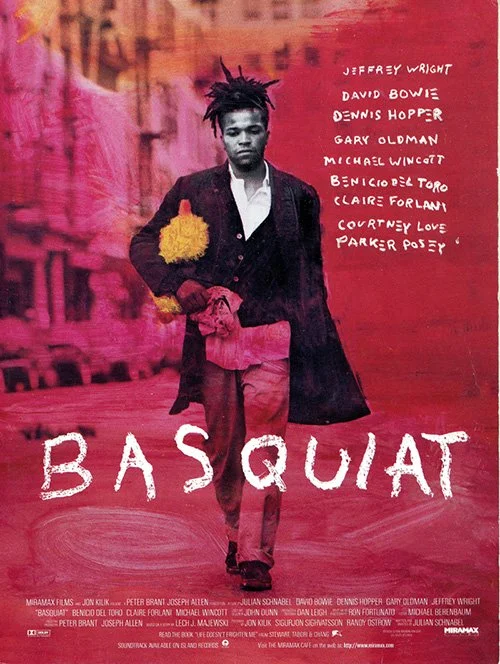
Poster used to promote Basquiat.
When the movie was released, in the summer of 1996, it packed a wallop. It received strong reviews in many top newspapers and was nominated for best picture at the Venice Film Festival. The film attracted almost seven hundred thousand viewers during its theatrical run in the United States, with even more when it was released internationally. With it, Basquiat achieved a level of stardom that was previously unimaginable for a visual artist, propelling him far beyond the confines of the art world.
Despite its success, Gérard Basquiat hated the movie. “He was always against it,” remembered Brant. “He didn’t want us to do it, even though we were friends. Any mention of drugs or anything like that, he would not approve of it.” Gérard discouraged those in his circle from assisting with the production and refused to grant Schnabel permission to use images of Jean-Michel’s artwork in the film. The ever-determined Schnabel came up with a clever workaround: he simply created all the faux-Basquiat works seen in the movie.
The Basquiat Estate’s Lawsuit Against Biographer Phoebe Hoban
Two years after the movie was released, Basquiat’s fame expanded further with the publication of a biography with a provocative title. Basquiat: A Quick Killing in Art, by Phoebe Hoban, presented a narrative of sex, drugs, and fame leading inexorably to Basquiat’s death. The New York Times reviewer observed that “Hoban leaves little to the imagination in her unsettling biography of the painter.” Filled with long quotes from her interviewees, “the resulting vignettes read like pulp fiction,” said the reviewer, noting that this helped make the unauthorized biography “compulsively readable.”
Yet for Gérard, reading page after page filled with sordid details about his son’s drug- and sex-filled lifestyle was painful. Unlike the stylized docudrama of the Basquiat movie, Hoban’s book, as the Times reviewer noted, left little to the imagination indeed. Gérard’s pain soon turned into the apparent need for revenge. A few months after the book came out, just moments before Hoban was set to begin an evening lecture at a university, she was served. Someone walked up to her and, after confirming her identity, handed her documents that named her in a lawsuit. Her publisher was served the next day.
Interestingly, Gérard was not suing them for defamation or invasion of privacy. Those types of cases would have been difficult to win, due to Hoban’s First Amendment rights and the thoroughness of her research. He had instead chosen to sue for copyright infringement. While Hoban’s book did not include any full reproductions of Basquiat’s artwork, it did feature twenty-five photographs of Jean-Michel and individuals in his life. Seven of these images included snippets of Basquiat’s artwork in the background or alongside the photographed individual. It was the presence of these fragments that became the basis for Gérard’s lawsuit.
In commercial endeavors such as books or movies, it is important to obtain permission from the copyright owner before using even seemingly innocuous image fragments. If obtaining permission is costly or challenging, the offending image can be blurred out. This is why obscured artworks are often seen in magazine articles and TV shows. If Hoban and her publisher had had a more amicable relationship with Gérard, perhaps he would not have taken legal action. However, he detested the book.
For their relatively innocuous transgressions, Hoban and her publisher were now potentially liable for substantial penalties. U.S. copyright laws set statutory minimums for each instance of copyright infringement. Gérard claimed in his lawsuit that because seven artworks were used illegally, he was entitled to a minimum of $700,000 in damages; there were also other demands.
The attorneys representing Hoban and her publisher responded to Gérard’s complaint by denying that the “book embodies reproductions of the Works and that such alleged reproductions constitute infringement of copyright in the Works.” Nevertheless, several months later, they reached an out-of-court settlement, the specifics of which were not disclosed to the public.
How the Basquiat Estate Influenced Museum Exhibitions
Less visible than Gérard’s battles with filmmakers and biographers was the influence he exerted over museum curators. Museums and galleries eager to organize exhibitions featuring Jean-Michel’s works had to obtain Gérard’s approval before using artwork images in their catalogs. If they were denied, their hopes of mounting an exhibition would be dashed. Gérard’s censorious requirements restricted what many felt permitted to say about Basquiat’s fraught family life, bisexuality, and struggles with addiction. Consequently, much of the literature produced over the past three decades has tended to overlook or trivialize numerous critical influences that shaped Jean-Michel’s artwork.
One curator who worked with Gérard spoke of how he expressed his editorial demands. To support the exhibition, Gérard had a condition: he needed to read the catalog essays well in advance of publication, to ensure that what was being said was truthful—a seemingly benign request. However, as the curator got to know Gérard better, it became evident which topics would provoke his ire. “He wanted to continue to be a father to his son, even though Jean-Michel was now dead,” the curator told me. “He didn’t want his son to take drugs. Moreover, for a man from his generation, it was very problematic that Jean-Michel was bisexual. The things he didn’t want Jean-Michel to do in his lifetime were the things he didn’t want mentioned or highlighted in the catalog.” When these topics were raised, Gérard would aggressively push back and challenge the curator for evidence, saying, “Were you in the bathroom or bedroom with him?” In need of Gérard’s support, the curator, like many others, felt compelled to downplay Jean-Michel’s struggles with addiction and meticulously avoid any mention of his sexuality.
Gérard’s ire also extended to lines of inquiry about Jean-Michel’s traumatic family life. Requests to interview Matilde or her family were routinely dismissed by Gérard, which enabled him to be the only storyteller available for information and insights about Jean-Michel’s formative years. Not wanting to rock the boat, curators found it best to advance a romanticized view of Jean-Michel’s difficult childhood.
How Gérard Basquiat’s Censorship Shaped Interpretations of His Son’s Art
Gérard’s efforts to control what was written about his son resulted in a sanitized narrative of Jean-Michel’s life, lacking much of the depth and history that could inform a richer understanding of his art. Given how intimately Basquiat’s work was connected to his personal experiences, these omissions matter. Consider four aspects of his life whose artistic significance has received insufficient attention.
Basquiat’s Drug Use and Creative Process
Like other celebrated creatives, including Janis Joplin, Charlie Parker, and Kurt Cobain, heroin was an extraordinarily dangerous yet important way for Basquiat to boost his productivity. Victor Bockris, known for his extensive writings on influential cultural figures such as Keith Richards, Patti Smith, and the Velvet Underground, described how drugs affected Jean-Michel’s creativity. Bockris began his career in 1977 working at Andy Warhol’s Interview magazine. His circle of friends included Debbie Harry, the lead singer of Blondie, and William Burroughs, the noted Beat Generation author. It was through his connection with Harry, who had a close relationship with Jean-Michel, that Bockris was introduced to him in 1981. Learning of Jean-Michel’s affinity for the Beat Generation, Bockris then introduced him to Burroughs. The four of them were soon spending time together.
“You need to have a very intelligent view of drugs,” Bockris said. “When you take the right amount of heroin, it gives you a lot of energy. If you take too much, you get listless. It’s a remarkably good drug to work on because it completely unplugs your worry cord. Many artists are high-strung, ultra-nervous individuals living on tightropes from which they cannot afford to look down. Heroin cures those ills by pulling that cord right out of its socket.” The energy and relief it provides “makes you eager to live, happy to be alive, blessed and vigorous. You feel very excited about what you’re doing and just want to get on with your work.” Of course, the drug can be a terrible trap. “I would never encourage anyone to take it,” Bockris added, “because it just takes your soul, it takes your life, it destroys everything. It catches up with you very badly, but it’s often a three-year honeymoon before the ugly addiction issues kick in.”
Bockris believes that Jean-Michel was a controlled drug taker in his early years because he was always in good shape. “He wasn’t slovenly, like so many people get on drugs. He hadn’t lost a sense of time or a sense of mission yet.” During this period, Basquiat was extraordinarily productive, making many of his best works. Bockris suggests that “one must view his drug taking as being something that played quite a vital role in his rise to fame. It gave him the ability to work for long periods of time and to be creative without worry or fear.”
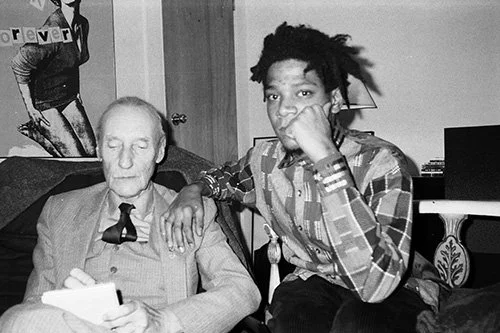
Basquiat and William Burroughs, December 1986.
By Bockris’s accounting, Jean-Michel’s heroin honeymoon ended in 1985. At the end of the honeymoon phase, addicts need ever larger amounts of the drug to achieve their previous highs. But no matter how much they take, the experience they crave proves elusive. It’s one of the great traps associated with using heroin. William Burroughs, who wrote about his own heroin addiction, told Bockris about visiting Basquiat at his Great Jones studio. He arrived to find the dining table piled high with empty heroin bags. When Burroughs told Jean-Michel that it was ridiculous to be using so much of the drug, Basquiat happily replied that he could handle more of it than anyone else.
As Basquiat’s drug use accelerated, his productivity declined. So, too, did the quality of his work. Unlike his earlier pieces, which are filled with crossed-out words and heavily painted surfaces, the late works often have a rudimentary and incomplete feel. Curators prone to puffery will sometimes refer to these late works as being highly experimental and playful. They may be, but more realistically, many are probably the result of a now-listless artist high on too much heroin looking for a quick and easy way to make paintings for upcoming exhibitions. Basquiat’s addictions were simply too central to his short life to downplay the impact they had on his art making.
Basquiat’s Bisexuality and the Interpretation of His Art
Gérard’s control over the official family narrative also prevented writers who needed his support from exploring Jean-Michel’s sexuality. Freed from this constraint, curators might find hints or allusions to Basquiat’s sexuality within his work. One notable aspect of Basquiat’s output is the conspicuous absence of women within it. One scholar who meticulously examined the thousands of paintings and drawings he created identified only nine instances of full-length female figures. Instead, Basquiat predominantly showcased images of Black men, often portraying them naked with raised arms.
Curators typically interpret these figures as a visual manifestation of resistance against racial injustice, symbolizing empowerment, defiance, and a challenge to societal structures perpetuating racism. While this interpretation provides an important perspective, additional viewpoints exist. For instance, a gay collector familiar with Basquiat’s bisexuality shared with me his belief that Jean-Michel’s anger extended to both the racism and the homophobia he experienced during the 1970s and 1980s. From this collector’s perspective, heteronormative interpreters of Basquiat’s work have been too quick to approach him solely through a race-based lens.
Jasper Johns provides an interesting case of how interpretations of an artist’s work have evolved over the past two decades and what it may mean for Basquiat. Johns has never openly discussed his sexuality or his relationship with fellow artist Robert Rauschenberg. Likewise, Johns has not explicitly addressed his homosexuality in his artwork. Yet many art critics and scholars now interpret certain elements within it as reflective of his sexual identity.
Jonathan Katz, a professor at the University of Pennsylvania, is a seminal figure in the realm of queer art history, with one of his focus areas being the work of Jasper Johns. “Johns is a highly intelligent and perceptive thinker about questions of identity and representation,” Katz shared. “Johns enjoys exploring how meaning is constructed, how it is socially molded, and how significance is bestowed upon things. In the 1950s, when he was maturing as an artist, it was a time of great homophobic violence, arguably the worst era to be queer in America. If you risked being branded as perverted, or otherwise criminalized by virtue of your sexuality, then the question of how meaning clings to social constructs became a matter of great interest to him.”
Like many artists, Johns delights in being elusive regarding the interpretation of his work. When questioned about it, he often speaks in riddles or deflects the inquiry back onto the questioner. Yet time and again, scholars have discovered traces of his sexuality within his work, including references to his painful breakup with Robert Rauschenberg, inspirations drawn from gay poets such as Frank O’Hara and Hart Crane, and the incorporation of physical objects, like balls and a plaster cast of a penis.
In the late 1950s, Johns embarked on his now iconic flag series, in which he depicted the American flag through a series of paintings, drawings, and prints. At first glance, these works appear to be straightforward representations of the flag. But on closer examination, the juxtaposition of a widely recognized symbol crafted with unexpected materials and techniques, such as collage and encaustic, in various colors and sizes, helps to muddle its traditional symbolism. “There’s nothing real about a flag,” Katz said. “A flag is a social and cultural construct, endowed with significance by us. Each variation in the flag series constitutes a kind of philosophical inquiry. If I paint the flag entirely in white, to what extent does its meaning remain unchanged? If I place two flags next to each other, does it alter the meaning?”
One of the few instances Katz found of Johns directly addressing homosexuality is in a drawing he created in 1969 titled Two Flags. Katz explained, “It’s one of his classic flag drawings where he beautifully renders two flags hanging vertically next to each other—a motif he returned to frequently in his work. On the back of this drawing, Johns wrote in his distinctive handwriting ‘drawing of two fags.’ It’s notable that he created this piece in the year of the Stonewall riots, which helped ignite the modern LGBTQ civil rights movement.” Basquiat’s Black bodies, like Johns’s flags, may spring from similar impulses.
Basquiat’s Childhood Trauma
Basquiat’s childhood was also marked by significant trauma, including a life-threatening car accident, periods of intense parental discord, and the loss of his mother to recurring bouts of mental illness. According to curators who worked with Gérard, he steadfastly refused to discuss his son’s childhood or adolescent sufferings, which led many writers to present a streamlined and romanticized view of Jean-Michel’s upbringing. As a result, essays in estate-supported publications overlook the connection between youthful suffering and the imagery Basquiat used in his artwork. The gripping sadness that permeates so much of his best work—in the scowling faces, the disembodied figures, the nihilistic phrases—is rarely associated with his youthful misery.
Basquiat’s Puerto Rican and Haitian Heritage
Basquiat’s complex cultural identity is similarly oversimplified. When curators discuss Basquiat’s cultural heritage, they tend to underplay his notable Puerto Rican identity while overstating his tenuous associations with Haiti. Jean-Michel’s early childhood was spent in a multigenerational Puerto Rican household with his maternal grandparents, aunts, uncles, and cousins. During his high school years, he lived in Puerto Rico for two years and returned there at least once for an extended vacation. He spoke Spanish and often included Spanish words in his paintings and drawings.
By comparison, a Haitian identity is hard to find in his works. Jean-Michel once told a New York Times interviewer that he’d never been to Haiti and that there had been no Haitian art whatsoever in his home while he was growing up. Moreover, he didn’t speak Haitian Creole, the French-based language native to Haiti. Yet curators, when citing Jean-Michel’s cultural background, often mention Gérard’s Haitian heritage first, followed by his mother’s Puerto Rican background, and tend to give them equal weight. Since Gérard controlled the estate’s licensing rights, it’s not surprising that those who needed his support would foreground his heritage over Matilde’s vastly more important Puerto Rican influence.
Who Controls an Artist’s Legacy?
Gérard’s editorial stipulations, particularly regarding sensitive topics like addiction, sexuality, and early traumas, have significantly influenced much of the serious art historical criticism that has been written about Jean-Michel over the past three decades. Paradoxically, for an artist whose work is so profoundly tied to his personal identity, much of the existing literature has neglected critical aspects of his character and life experiences.
The practice did not end with Gérard’s death in 2013. The Basquiat Estate refused permission to include images of his artwork in my biography, Jean-Michel Basquiat: The Making of an Icon, precisely because these issues are openly addressed.
Caption: Gérard Basquiat and his son, Jean-Michel (1985).
Want to Go Deeper into Basquiat’s Story?
This article is drawn from Jean-Michel Basquiat: The Making of an Icon, the first major biography of Basquiat in more than 25 years. Based on more than 100 interviews, court records, family archives, and previously unpublished documents, the book moves beyond familiar myths to offer a fuller account of Basquiat’s life, art, career, and posthumous rise, including new revelations about his childhood, relationships, artistic development, and transformation into a global icon.
About Doug Woodham
Doug Woodham is an economist and art-market adviser whose career has spanned consulting, technology, and the art world. He is Managing Partner of Art Fiduciary Advisors, where he advises collectors and families on financial decisions involving art. He previously served as President of Christie’s Americas and as a Partner at McKinsey & Company.
He holds a Ph.D. in economics from the University of Michigan and is the author of Jean-Michel Basquiat: The Making of an Icon and Art Collecting Today: Market Insights for Everyone Passionate About Art.